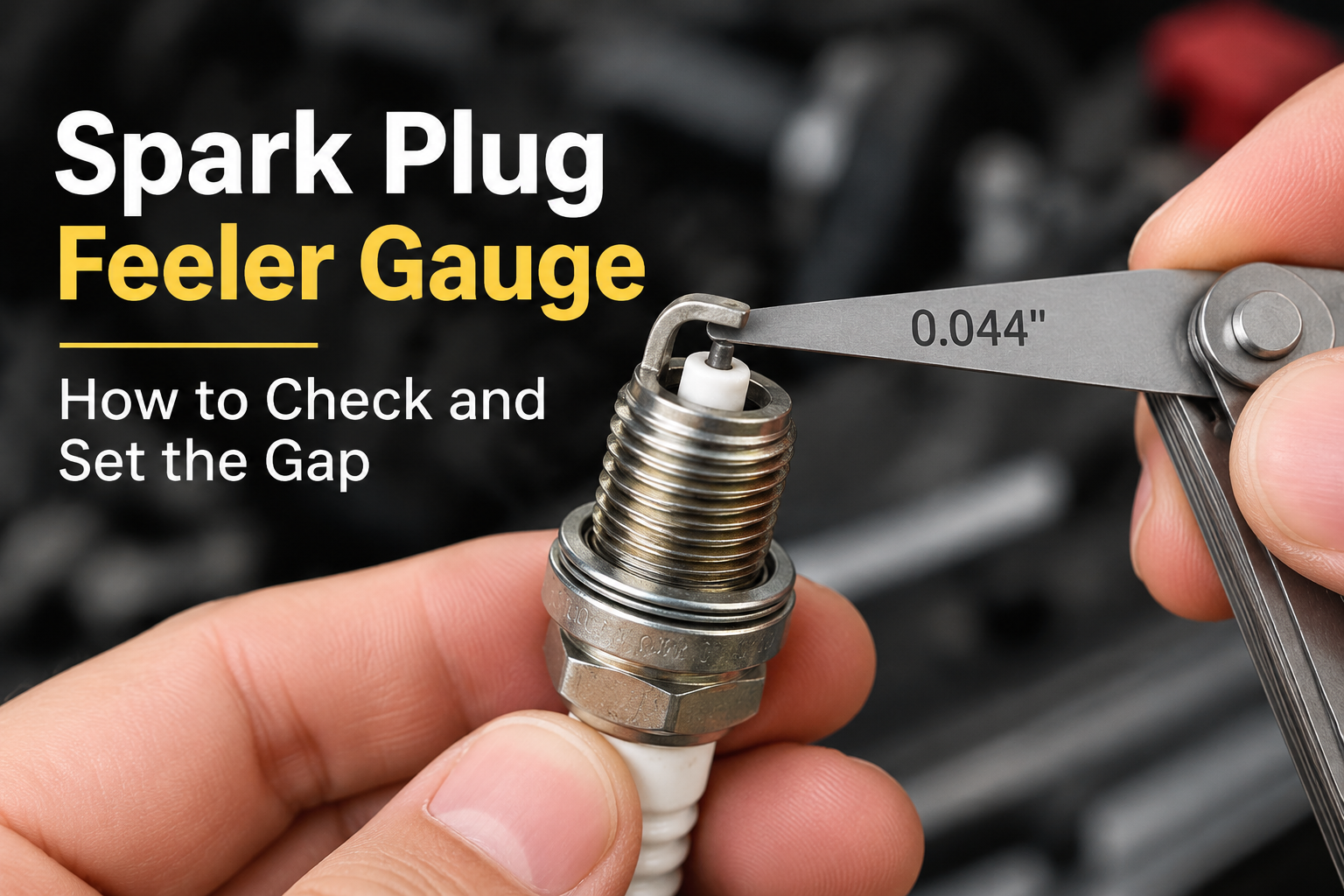
To check a spark plug gap, slide a feeler gauge blade equal to your engine’s gap spec between the center and side electrodes. It should pass with a light drag. Many car plugs call for about 0.028 to 0.060 in (0.7 to 1.5 mm), but your engine’s own spec is the only number that counts.
The right method depends on your plug type. New plugs, used plugs and fine-wire iridium plugs each need slightly different care. This guide covers how to find your spec, how to check and set the gap, three worked examples, and the mistakes that damage plugs.
What a Spark Plug Feeler Gauge Does
A spark plug feeler gauge is a set of thin metal blades or wires, each of a known thickness. You slide a blade into the gap between the two electrodes to measure it. The blade that fits with a light drag equals the gap size.
The gap is the distance the spark must jump. A wrong gap can cause a weak spark or misfires, so it is worth a minute of checking.
Find the Right Gap for Your Engine
Look up your spec before you touch the plug. Check the owner’s manual, the under-hood emissions label or the plug maker’s guide. Do not set a gap from memory.
These ranges are typical only. Verify against your manual or the plug maker.
| Engine type | Typical gap range | Where to confirm |
|---|---|---|
| Many modern cars | about 0.028 to 0.060 in (0.7 to 1.5 mm) | Owner’s manual or under-hood label |
| Small engines (mower, trimmer) | roughly 0.020 to 0.030 in (0.5 to 0.8 mm) | Engine manual or plug maker |
Many gap specs come in inches or millimeters. Use this table to convert.
| Inches | Millimeters |
|---|---|
| 0.024 | 0.61 |
| 0.028 | 0.71 |
| 0.030 | 0.76 |
| 0.032 | 0.81 |
| 0.035 | 0.89 |
| 0.040 | 1.02 |
| 0.044 | 1.12 |
| 0.050 | 1.27 |
| 0.060 | 1.52 |
How to Check the Gap With a Spark Plug Feeler Gauge
Do this with the plug out of the engine and the engine cool. The steps are the same for new and used plugs.
- Get the spec. Write down your gap in inches and millimeters.
- Inspect the plug. Look for a cracked white insulator, heavy deposits or worn, rounded electrodes. Replace a damaged plug instead of gapping it.
- Wipe the blade. Dirt or oil on the blade can skew the fit.
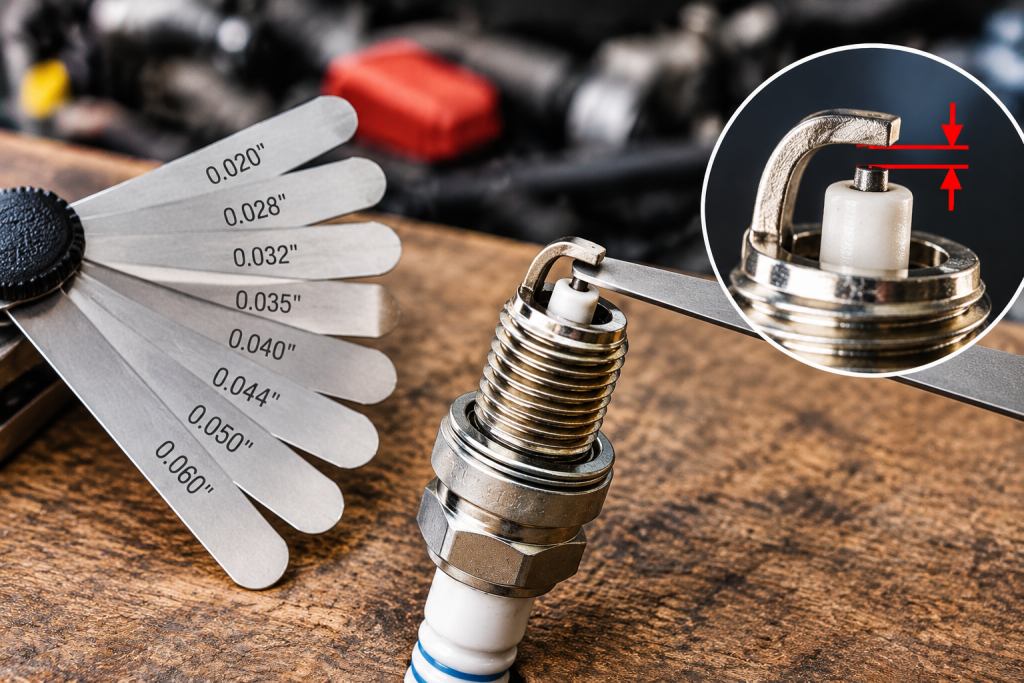
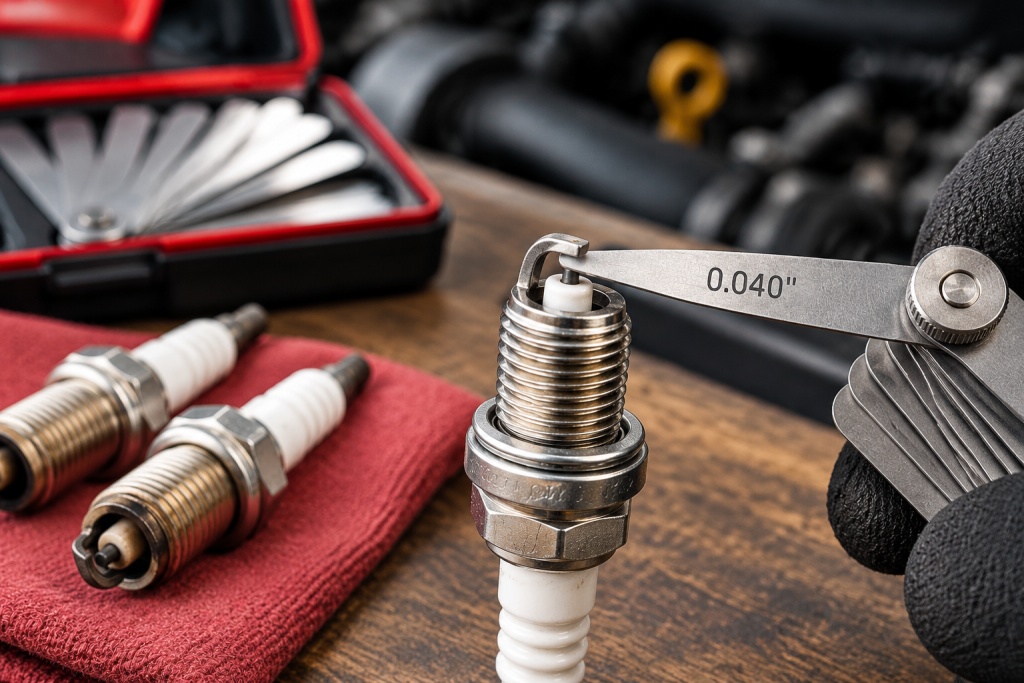
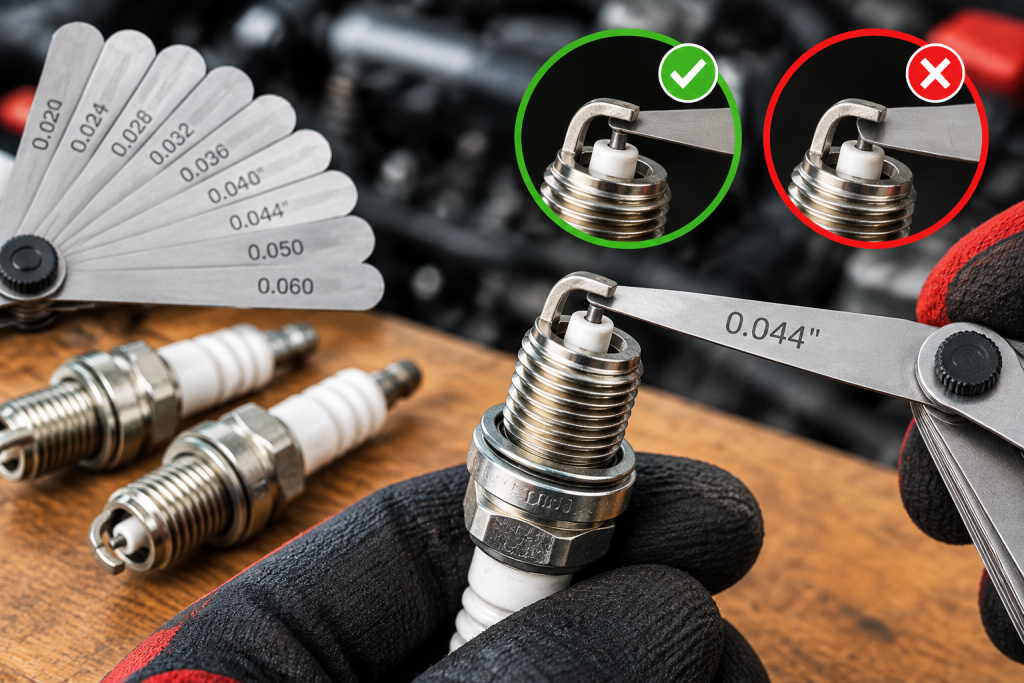
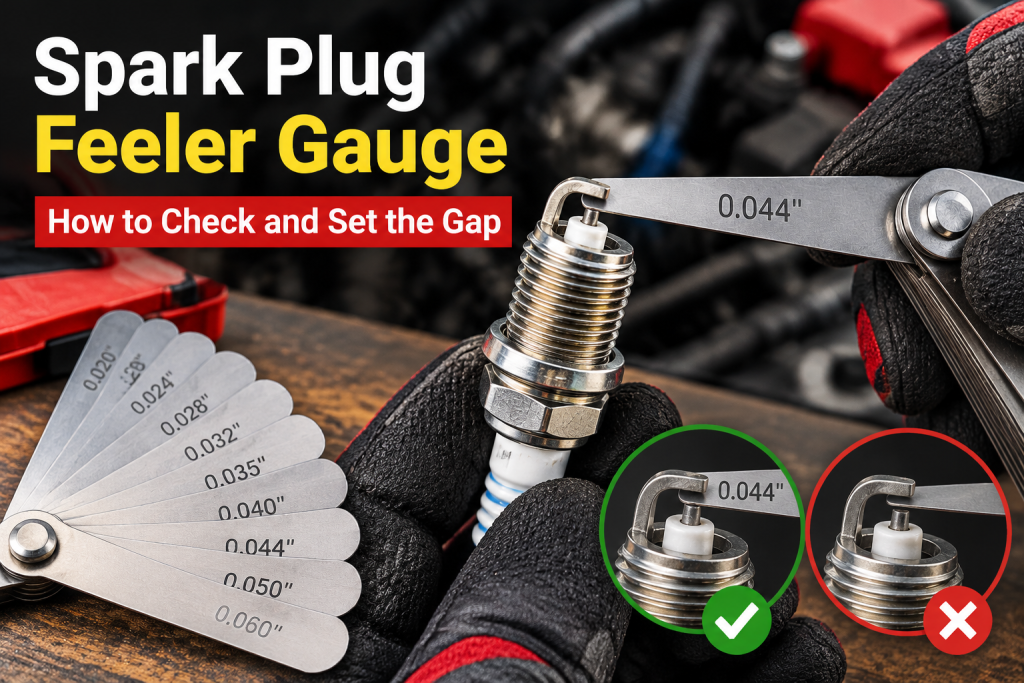
- Pick the blade that equals the spec. For a 0.044 in (1.1 mm) gap, choose the 0.044 in blade.
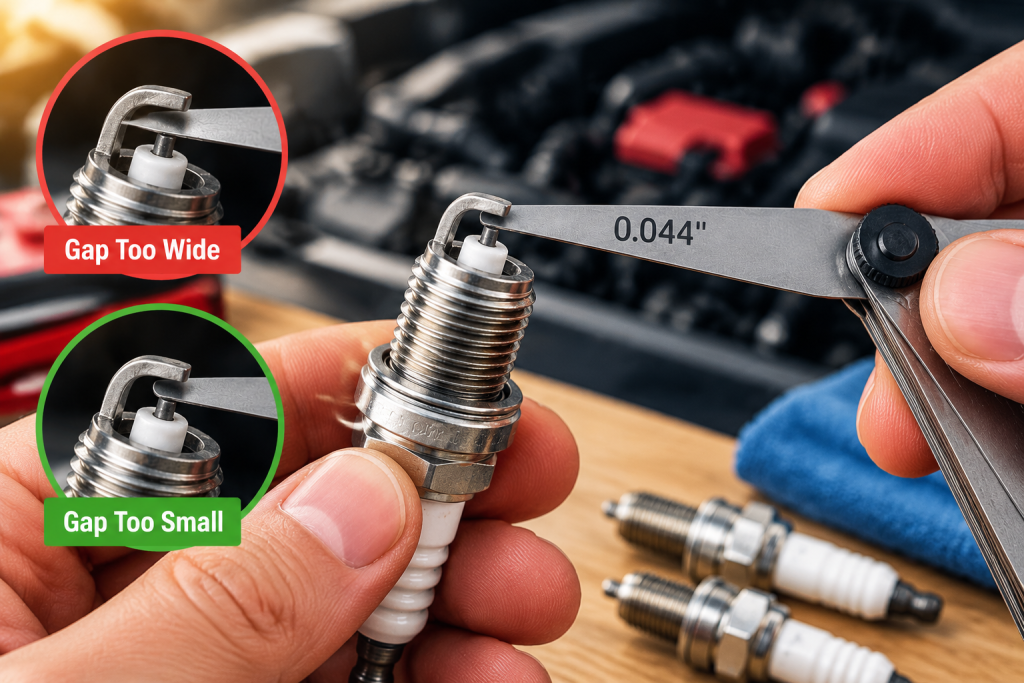
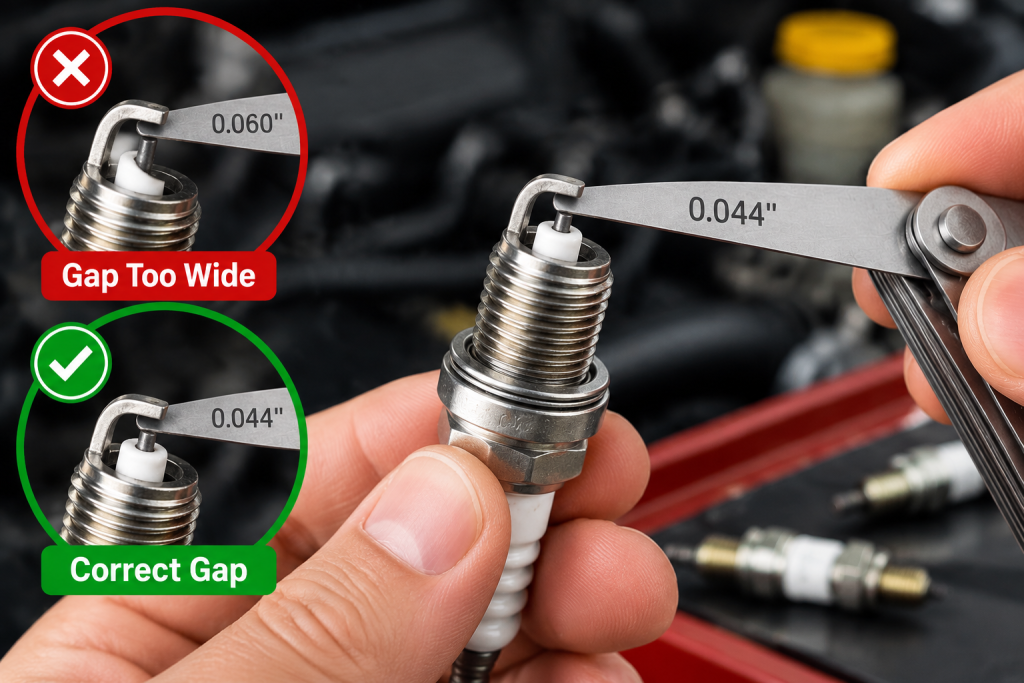
- Slide it in. Put the blade between the center electrode and the bent side (ground) electrode. It should pass with a light drag.
- Test the next size up. A blade 0.002 in (0.05 mm) thicker should not fit.
- Decide. If the spec blade is loose, the gap is too wide. If it will not enter, the gap is too small.
How to Set the Gap
If the gap is off, bend only the side electrode. Never bend or pry on the center electrode. It holds the ceramic insulator and can break.
- To close a gap that is too wide, gently press the side electrode against a hard, flat surface. Go slowly.
- To open a gap that is too small, use the lever on a gap tool and bend the side electrode out by a tiny amount.
- Recheck after every small bend. Repeat until the spec blade slides in with a light drag and the next size up does not fit.
- Do not bend it back and forth. Repeated bending can crack the electrode.
Fine-wire iridium and platinum plugs are delicate. Many makers say not to adjust them. Follow the plug maker’s instructions.
Worked Examples: Reading and Converting Gap Sizes
The rule: the largest blade that slides in with a light drag equals the gap.
Example 1: reading a gap
- Your spec is 0.044 in (1.12 mm).
- The 0.044 in blade slides in with a light drag.
- The 0.046 in blade will not fit.
- The gap is between 0.044 and 0.046 in (1.12 to 1.17 mm). Good.
Example 2: converting a metric spec
- Your spec is 0.8 mm. Your set is in inches.
- Convert: 0.8 ÷ 25.4 = 0.0315 in.
- The closest blade is 0.032 in. Check: 0.032 × 25.4 = 0.8128 mm.
- That is about 0.013 mm off the spec, which is a very small difference.
Example 3: closing a gap that is too wide
- Your spec is 0.044 in (1.12 mm). The 0.052 in (1.32 mm) blade slides in with a light drag.
- The gap is too wide by 0.052 − 0.044 = 0.008 in, which is 0.20 mm.
- Press the side electrode down a tiny amount and recheck.
- Stop when the 0.044 in blade drags lightly and the 0.046 in blade will not fit.
Flat Blade or Wire Type?
Feeler gauges come in two main styles. The right one depends on the electrode shape.
| Type | Best for | Watch out for |
|---|---|---|
| Flat blade | New plugs with flat electrode faces | Can read too small on worn, rounded electrodes |
| Round wire | Used plugs with worn or curved electrodes | Needs a clean, straight wire |
Why Real Results Differ From the Ideal
Even a careful check can be off. These are the common causes.
You can check your own gauge. Measure each blade’s thickness with a micrometer or caliper and compare it to the marking. See our guides on how to read a micrometer and how to read a vernier caliper. Then check the same plug three times around the electrode. The feel should be the same each time.
Common Mistakes With a Spark Plug Feeler Gauge
Avoid these and you will avoid most damage.
- Trusting pre-gapped plugs. They can be off from the box, so check every plug.
- Prying on the center electrode. Bend only the side electrode.
- Using a flat blade on a worn plug. Use a round wire gauge instead.
- Forcing the blade. It should slide with a light drag, not a hard push.
- Using a rusty or bent blade. Replace damaged blades.
- Over-bending the electrode. Make tiny changes and recheck.
- Setting the gap from memory. Always check your own engine’s spec.
Safety Notes
Spark plug work involves ignition parts and a hot engine. Take these steps first.
FAQ
What size feeler gauge do I need for a spark plug? The one that equals your engine’s gap spec. Find it in your manual or on the under-hood label, then use the matching blade.
Do new spark plugs need to be gapped? Many come pre-gapped, but the gap can shift in shipping or differ from your spec. Check every plug before you install it.
Should I use a flat or wire feeler gauge? Use a flat blade on new plugs with flat electrodes. Use a round wire gauge on used plugs, since worn electrodes can fool a flat blade.
Can I adjust an iridium spark plug? Many makers say not to. Their fine center electrode is easy to damage. If you must adjust one, bend only the side electrode and follow the plug maker’s instructions.
What happens if the gap is wrong? A gap that is too wide can cause misfires. One that is too small can give a weak spark. Setting the correct gap helps the engine run smoothly.
Final Thoughts
The method is simple: get your spec, pick the matching blade, check for a light drag and adjust only the side electrode. Go slowly and recheck after every small bend.
Expect small differences between blades and between people. A good set of blades and a steady hand will get you close, and the engine’s spec sets the target. If a plug looks damaged or worn, replace it. Gapping will not fix a bad plug.