Laser distance meters are fast, simple, and very useful. But they are not perfect. The limitations of laser distance measurement become clear when the target is far away, shiny, dark, outdoors, or partly blocked.
When I looked closely at how laser distance tools behave in real working situations, one thing stood out: most bad readings are not caused by the laser itself. They often come from the target, the angle, the light, or the way the tool is held.
Here are the main limits I think every user should understand before trusting a laser distance reading.
What Are the Main Limitations of Laser Distance Measurement?
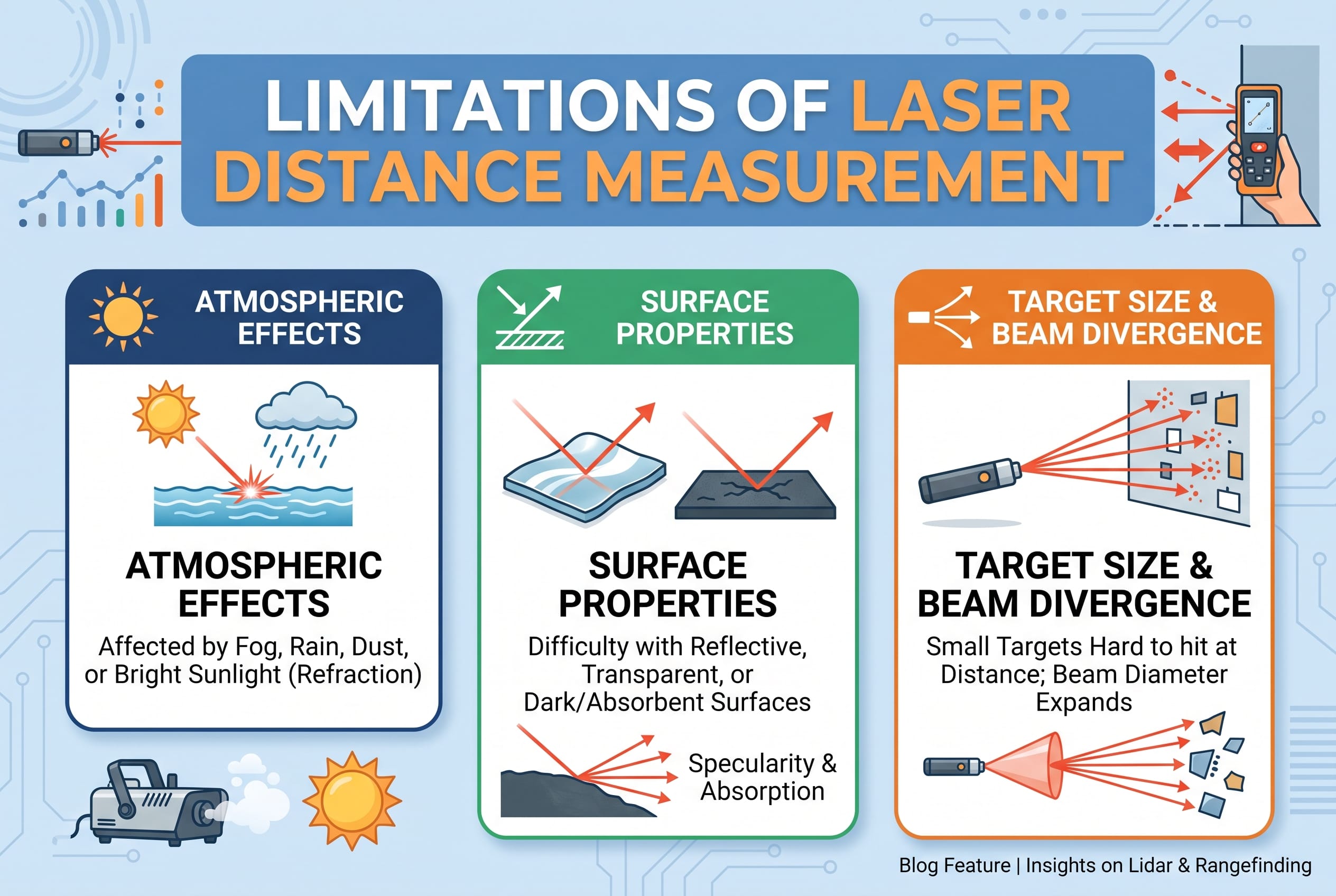
The biggest limits come from the target surface, distance, light, angle, and tool setup. A laser distance meter needs a clear path to the target and enough reflected light to calculate the distance.
| Limitation | What can happen |
|---|---|
| Poor target surface | Weak or unstable readings |
| Strong sunlight | Harder for the sensor to detect the laser |
| Wrong angle | Reading may change or fail |
| Long distance | Accuracy can drop |
| Blocked line of sight | Tool measures the wrong point |
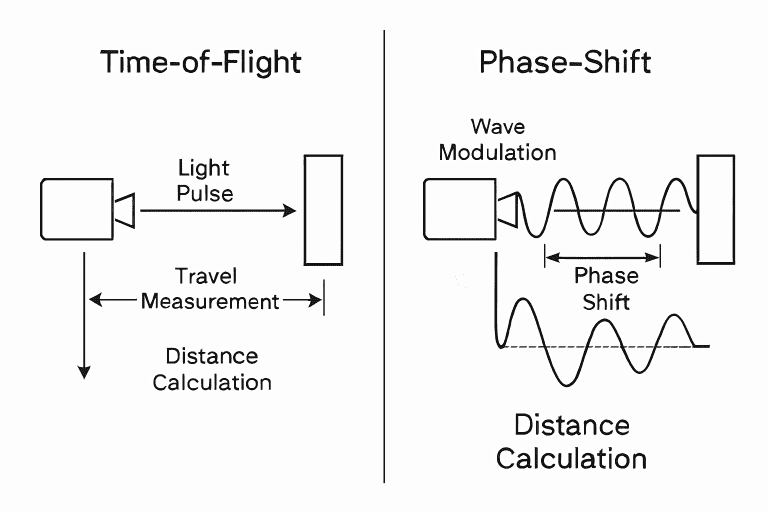
A common mistake is to think that a laser distance meter simply “sees” the target. It does not work quite like your eyes. It sends a laser beam and measures the returning signal.
That means the quality of the reflected signal matters a lot.
How Target Surfaces Affect Laser Distance Measurement
The surface you measure can make a surprising difference. Light-colored, flat, and fairly matte surfaces are usually easier for the sensor to detect.
Dark or highly reflective surfaces can be harder.
Why dark surfaces can cause problems
A dark wall may absorb more of the laser light instead of reflecting enough of it back to the sensor. A glossy surface can create another problem by reflecting the beam away from the device.
| Target surface | Likely result |
|---|---|
| Matte white wall | Usually easy to measure |
| Dark fabric | May give a weak or failed reading |
| Glass or mirror | Can reflect the beam unpredictably |
I would not assume that a failed reading means the distance meter is broken. Changing the target can solve the problem immediately.
For difficult surfaces, placing a suitable target card on the measurement point can make the reading much more reliable.
Why Angle Is One of the Most Overlooked Limitations
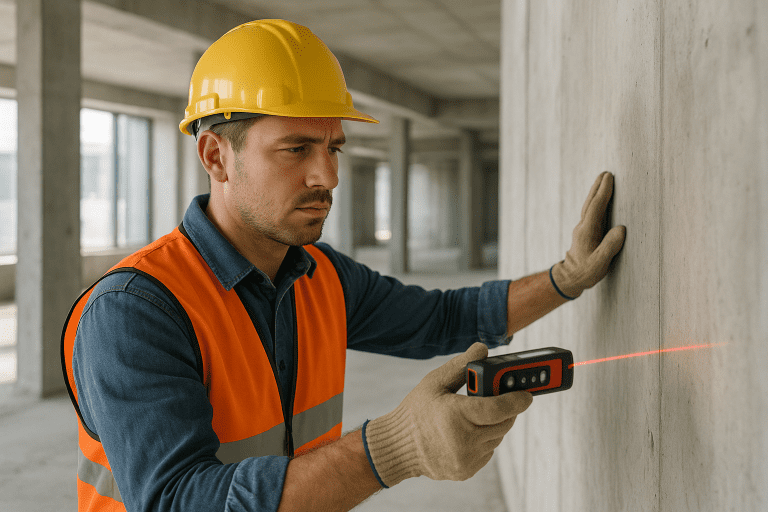
The laser should hit the target as directly as possible. If I point the tool at a sharp angle, the beam can bounce away instead of returning cleanly to the sensor.
This is especially important when measuring walls, ceilings, floors, and other large flat surfaces.
What happens with an angled target?
Imagine measuring a wall from across a room. If the tool is tilted too much, the laser may not return to the sensor correctly.
| Situation | Better approach |
|---|---|
| Measuring a flat wall | Keep the tool square to the wall |
| Measuring a ceiling | Use a stable position |
| Measuring from a corner | Check the reference point carefully |
This is one reason a shaky hand can create more trouble than people expect. Even a good laser meter cannot fix poor positioning.
Outdoor Laser Distance Measurement Has Extra Problems
Outdoor use is one of the clearest examples of the limitations of laser distance measurement.
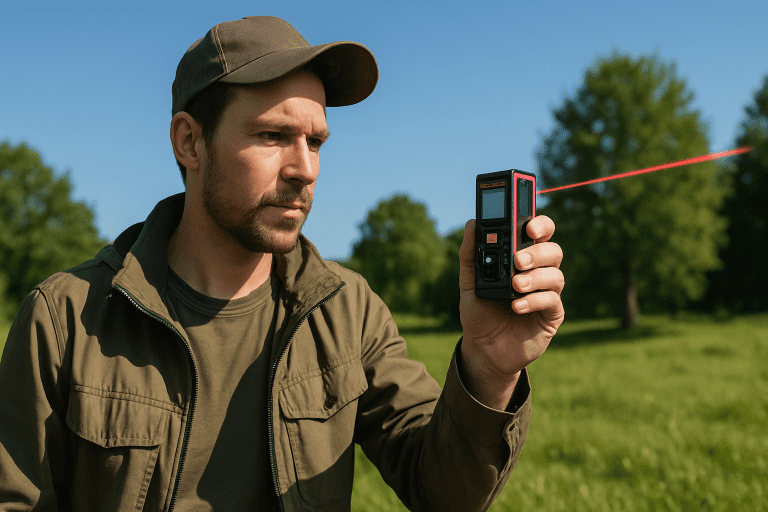
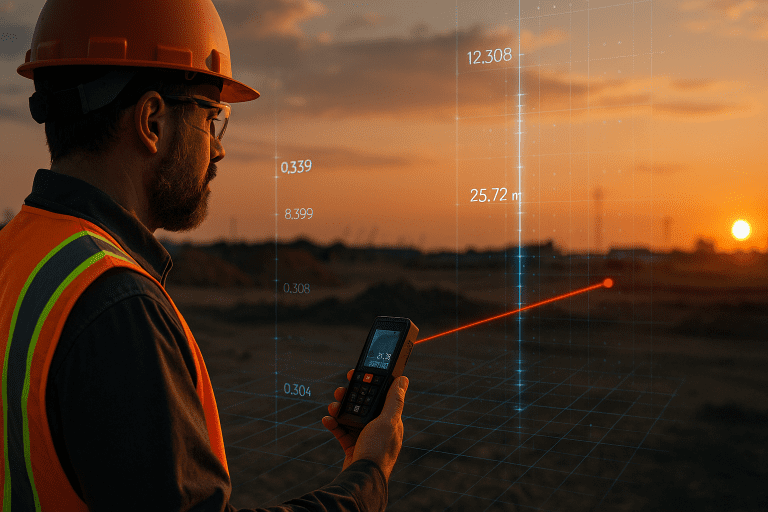
Bright sunlight can make it harder to see the laser dot. More importantly, strong ambient light can make it harder for the sensor to detect the returning laser signal.
I found this point easy to underestimate when comparing indoor and outdoor use. A tool that feels extremely easy to use inside may need much more care outside.
Why sunlight makes long measurements harder
As the distance increases, the laser spot becomes harder to see and the returning signal becomes weaker. Bright outdoor conditions can make that problem worse.
| Outdoor problem | Practical response |
|---|---|
| Laser dot is hard to see | Use the tool’s digital viewfinder if available |
| Bright sunlight | Measure from a shaded position when possible |
| Distant target | Use a suitable target surface |
A tripod can also help when the measurement is long or needs to be repeated.
Long-Distance Measurements Are Not Always Reliable
Every laser distance meter has a specified measuring range. That range should not be treated as a guarantee of perfect results under every condition.
The maximum range may depend on the target, lighting, and measurement conditions.
A white wall in good conditions can be much easier to measure than a dark object at the same distance.
Why maximum range can be misleading
Suppose a device is rated for a long distance. That does not mean it will perform equally well at that distance against every surface.
| Condition | Effect on long measurements |
|---|---|
| Good target + low light | More favorable |
| Dark target + bright light | More difficult |
| Unstable tool position | Higher chance of error |
For important measurements, I would treat the rated range as a limit, not as a promise of ideal accuracy.
Laser Distance Meters Need a Clear Line of Sight
A laser distance meter cannot measure through an object simply because the target is visible from your position.
The laser needs a usable path between the tool and the measurement point.
This becomes an issue around furniture, pipes, machines, trees, walls, and other obstacles.
A visible target is not always a measurable target
A small opening can create another problem. You may see the surface behind the opening, but the laser could hit the edge of the opening first.
| Problem | What to check |
|---|---|
| Furniture blocks target | Move to a clearer position |
| Small opening | Make sure the laser reaches the intended surface |
| Multiple nearby surfaces | Confirm where the dot lands |
This is particularly important when measuring construction spaces where many objects are close together.
What About Accuracy, Resolution, and Measurement Error?
One thing I think users often mix up is accuracy and resolution.
Resolution tells you how finely the tool displays a measurement. Accuracy tells you how close that measurement is to the true distance.
A screen showing millimeters does not automatically mean the measurement itself is accurate to a millimeter.
Why the displayed number can create false confidence
| Term | Simple meaning |
|---|---|
| Resolution | Smallest displayed change |
| Accuracy | How close the result is to the true value |
| Repeatability | How consistently the tool gives the same result |
For normal room measurements, a small difference may not matter. For precise installation or layout work, it can matter a lot.
I would always check the manufacturer’s stated accuracy and the conditions used for that specification.
Temperature and Environment Can Also Matter
Electronic measuring tools are designed to work within certain environmental limits. Very hot, cold, dusty, or humid conditions may affect performance.
The effect will depend on the particular device.
A tool used in a clean indoor room has a much easier job than one used on a hot construction site.
| Environment | Possible concern |
|---|---|
| Very hot area | Tool may operate outside its ideal range |
| Very cold area | Battery and electronics may behave differently |
| Dusty site | Lens can become dirty |
| Humid conditions | Visibility and electronics may be affected |
This does not mean a laser meter cannot be used in difficult environments. It means the operating specifications are worth checking.
Common Mistakes That Make Laser Measurements Worse
Some problems are not really limitations of the technology. They are user errors that make those limitations more noticeable.
These were the kinds of mistakes I paid the most attention to when breaking down the practical side of laser measurement.
| Mistake | Better approach |
|---|---|
| Holding the tool loosely | Keep it steady |
| Measuring a shiny surface directly | Use a suitable target |
| Ignoring the reference point | Select the correct measuring edge |
| Trusting one unusual reading | Take another measurement |
| Measuring at a steep angle | Aim squarely at the target |
The last point is especially useful. If a measurement looks strange, do not immediately assume the tool is wrong.
Measure again from the same position. Then change the position or target and compare the results.
Can Laser Distance Measurement Replace a Tape Measure?
Not in every situation.
Laser distance meters are excellent for many room, wall, floor, ceiling, and long-distance measurements. But a tape measure can still be easier when the target is very close, blocked, flexible, irregular, or difficult for a laser to hit.
| Situation | Better choice |
|---|---|
| Long straight room | Laser distance meter |
| Small object | Tape measure may be easier |
| Blocked target | Tape measure may work better |
| Quick wall-to-wall measurement | Laser distance meter |
I see these tools as complements rather than replacements.
The best choice depends on what you are measuring.
How to Get Better Results Despite These Limitations
The easiest way to reduce measurement problems is to control the conditions as much as possible.
Keep the lens clean. Hold the device steady. Aim at a suitable surface. Check the reference point before pressing the measurement button.
For difficult measurements, repeat the reading instead of trusting the first number.
A simple accuracy check
| Step | What I would do |
|---|---|
| 1 | Check the measuring mode |
| 2 | Aim directly at the target |
| 3 | Hold the tool steady |
| 4 | Take a second reading |
| 5 | Compare unusual results |
If the two readings differ more than expected, investigate the setup before using the measurement for important work.
When Should You Avoid Relying on a Laser Distance Meter?
There are situations where another measurement method makes more sense.
If the target cannot be reached by the laser, the surface gives poor reflections, or the measurement has very high consequences, I would not rely on one laser reading alone.
For critical work, independent measurements can provide a useful check.
The key lesson is simple: a laser distance meter is a measurement aid, not a magic measuring device.
Final Thoughts
The biggest limitations of laser distance measurement are not usually complicated. Difficult surfaces, bright sunlight, long distances, poor angles, blocked paths, and incorrect setup can all affect the result.
Once you understand these limits, the tool becomes much easier to use well. Instead of blaming the device for every strange reading, you can look at the target, angle, environment, and measurement setup first.
My practical takeaway is to use laser distance meters for what they do best: fast, convenient measurements with a clear line of sight. When the conditions are difficult or the measurement is critical, slow down, repeat the reading, and use another method as a check when needed.