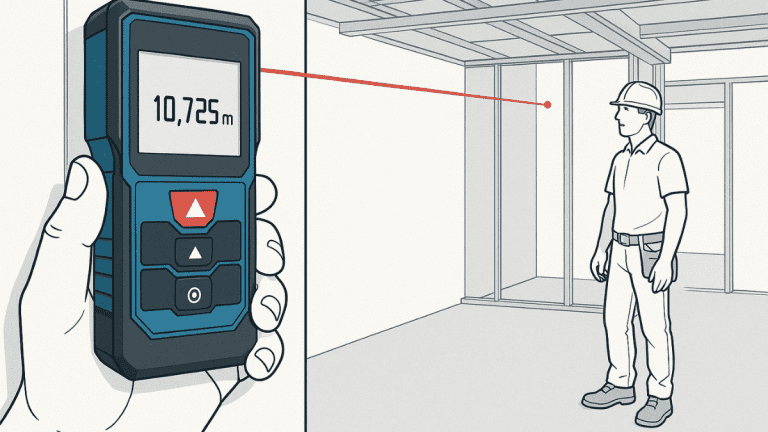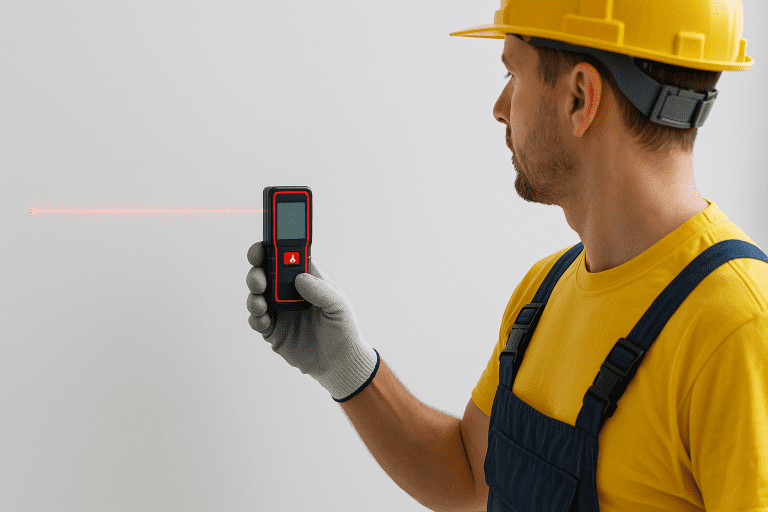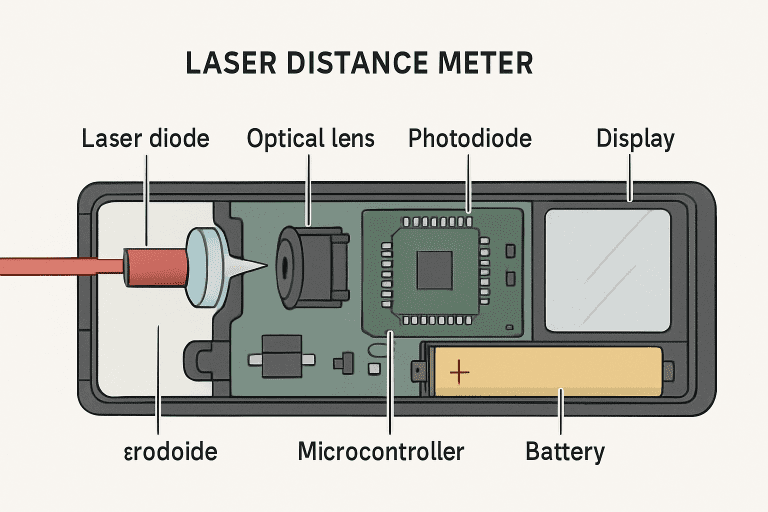
A good handheld laser meter can measure a room, wall, ceiling, or long distance in seconds. It is faster than a tape measure and can also calculate area, volume, and indirect distances. The hard part is choosing the right one because range, accuracy, display quality, durability, and price vary a lot.
For this Best Handheld Laser Meter guide, I compared current models from Bosch, Leica, Fluke, Milwaukee, and Klein Tools. I looked at specifications, expert reviews, recent owner feedback, build quality, useful features, and overall value. The goal is not to pick the most expensive meter, but the one that fits each type of user.
Best Overall: Bosch GLM165-27CGL
The Bosch GLM165-27CGL is the strongest all-round choice for most serious users. It combines a 165-foot range, ±1/16-inch stated accuracy, a green laser, Bluetooth, an inclinometer, rechargeable power, and IP65 protection.
Its green beam is easier to see than a typical red beam, while the color display and haptic feedback help on busy jobsites. The main concern is that recent owner feedback shows some reliability and setup complaints, so buyers should check the unit soon after purchase.
Pros And Cons
The Bosch offers a rare mix of jobsite durability and smart features without moving into the very high price range of specialist meters.
Pros | Cons |
|---|---|
Recommendation
Buy the GLM165-27CGL if you want one meter that can handle home projects, remodeling, estimating, trim work, and regular jobsite use. The inclinometer, Bluetooth connection, and multiple calculation modes make it more useful than a basic distance meter.
It is less attractive if you only measure short indoor distances. In that case, a simpler Bosch or Klein model can save money and reduce the number of functions you need to learn. Recent owners also report occasional quality-control issues, so buying from a reputable seller is sensible.
Best for: Contractors, remodelers, serious DIY users, and general professional use Not ideal for: Buyers who only need basic short-distance measurements
Best Value: Klein Tools 93LDM100C
The Klein Tools 93LDM100C takes a different approach. It is small, simple, and affordable rather than feature-heavy. It measures up to 100 feet and offers ±1/16-inch accuracy to 30 feet, changing to ±1/8 inch beyond that range.
Expert testing has also highlighted its simple controls, compact body, readable reverse-contrast display, and low price. Owner feedback is generally positive, although several users say the red laser becomes difficult to see outdoors.
Pros And Cons
This is one of the better choices when you want accurate basic measurements without paying for Bluetooth, advanced angle functions, or complex calculation modes.
Pros | Cons |
|---|---|
Recommendation
The 93LDM100C makes sense for homeowners, electricians, installers, and tradespeople who need a meter for quick measurements. Its pocket-friendly design also makes it easy to carry every day.
Skip it if you often measure across large rooms, outdoors, or in direct sunlight. Recent user feedback confirms that visibility is one of its main limits.
Best for: Budget buyers and simple everyday measurements Not ideal for: Long-range outdoor work or advanced measuring workflows
Best Premium: Leica DISTO D2
The current Leica DISTO D2 is aimed at users who want a compact meter with more advanced measuring functions. The current model offers a 150-meter range, ±1.5 mm typical accuracy, Bluetooth 6.0, NFC, a tilt sensor, Smart Room support, and a multifunctional endpiece.
The endpiece is particularly useful. It can automatically detect the measuring reference point when working from corners and edges. That makes the D2 a strong choice for interior layouts, finish carpentry, estimating, and floor-plan work.
Pros And Cons
The Leica costs more than simple handheld meters, but its feature set is designed for people who measure often and need more than straight-line distance.
Pros | Cons |
|---|---|
Recommendation
Choose the DISTO D2 when corner measurements, digital documentation, room plans, and high measurement accuracy matter. Its endpiece and smart functions can save time on repeated professional measurements. Leica lists the D2 among its current D-series products and continues to support it with the DISTO Plan ecosystem.
It is overkill for someone who only wants to measure a wall before buying furniture. The premium price is easier to justify when the advanced functions are used regularly.
Best for: Interior professionals, estimators, finish carpenters, and advanced users Not ideal for: Occasional users who only need simple distance readings
Best For Heavy-Duty Professional Use: Fluke 424D
The Fluke 424D is built for users who need long range, advanced calculations, and professional measurement functions. It reaches up to 330 feet with a Leica target plate and has a typical stated accuracy of ±1 mm. It also includes a 360-degree inclination system, compass, corner measurement features, and Pythagoras calculations.
Fluke also rates battery life at up to 5,000 measurements and gives the meter IP54 protection. The major downside is simple: it is expensive compared with basic handheld laser meters.
Pros And Cons
The 424D is less about convenience and more about giving professional users a broad set of measurement tools in one handheld unit.
Pros | Cons |
|---|---|
Recommendation
The Fluke 424D is a strong choice for professional estimating, construction, inspection, layout, and measurement work where advanced functions can save time. Its inclination and corner features are especially useful for difficult measurements.
For simple room measurements, however, it is hard to justify the extra cost. A Bosch, Klein, or Milwaukee meter can cover basic work for much less.
Best for: Professional contractors, inspectors, and advanced measurement work Not ideal for: Homeowners looking for a low-cost basic meter
Best Jobsite Value: Milwaukee 150′ Laser Distance Meter
The Milwaukee 48-22-9802 is a practical middle ground for users who work on jobsites and want a rugged, straightforward meter. It has a 150-foot range, ±1/16-inch stated accuracy, IP54 protection, a color screen, continuous measurement, and an impact-resistant overmold.
The two-position auto-detecting lever is another useful touch. It helps the meter recognize the measuring reference when working around corners. Milwaukee also includes 30-reading memory and a side-shot button for one-handed operation.
Pros And Cons
It does not have the connectivity ecosystem of Bosch or Leica, but its controls and physical design make sense for regular construction work.
Pros | Cons |
|---|---|
Recommendation
The Milwaukee is a good fit if you already use Milwaukee tools and want a jobsite-friendly meter that is easy to operate. It also makes sense for contractors who want more range and durability than a small pocket meter without paying for a premium Leica or Fluke.
Skip it if digital measurement transfer is important to your workflow. Bosch and Leica offer stronger connectivity options.
Best for: Construction workers, contractors, and Milwaukee tool users Not ideal for: Users who need Bluetooth documentation or advanced digital workflows
Comparison Snapshot
The five meters are not direct substitutes. Each has a clear reason to buy it, from simple pocket measurements to advanced professional work.
Product | Best For | Key Trade-Off |
|---|---|---|
Bosch GLM165-27CGL | Best all-round use | Some owner reports of reliability issues |
Klein 93LDM100C | Basic and budget work | Limited outdoor visibility |
Leica DISTO D2 | Premium indoor measurement | Higher price |
Fluke 424D | Advanced professional work | Very expensive |
Milwaukee 48-22-9802 | Rugged jobsite use | No wireless data transfer |
How I Chose These Products
During my research, I compared official manufacturer specifications with independent expert coverage and recent customer feedback. Pro Tool Reviews, for example, selected the Bosch GLM165-27CGL as its overall pick and the Klein 93LDM100C as its easy-to-use choice.
I also checked current manufacturer pages to avoid relying on old specifications. This matters because laser meter ranges, battery systems, connectivity, and model availability can change. Leica’s current D2 is a newer generation than older D2 listings, while the Fluke 424D and Milwaukee 150-foot model remain listed by their manufacturers.
Recent owner feedback was used mainly to identify practical weaknesses. For example, Bosch owners report both excellent accuracy and occasional complaints about firmware, battery drain, documentation, and defective units. Klein owners generally like the compact design, but outdoor laser visibility comes up as a limitation.
Evaluation Factor | Why It Matters |
|---|---|
Accuracy | Determines whether measurements are useful for real work |
Range | Shows how far the meter can measure reliably |
Laser Visibility | Affects targeting, especially in bright areas |
Durability | Important for tools carried on jobsites |
Ease Of Use | Reduces mistakes and speeds up measurements |
Smart Features | Useful for plans, records, and digital workflows |
Value | Balances useful features against purchase cost |
Common Buying Mistakes
The biggest mistake is choosing a laser meter by maximum range alone. A 300-foot rating does not help much if you mostly measure rooms and walls. Target reflectivity, lighting, and how steadily you can aim the meter also affect real-world performance.
Another common mistake is paying for features that will never be used. Bluetooth, tilt sensors, advanced Pythagoras functions, and floor-plan apps can be useful, but they also increase cost and learning time.
Mistake | Better Approach |
|---|---|
Buying the longest-range model | Match range to your normal work |
Ignoring laser visibility | Consider green beams for harder viewing conditions |
Assuming rated accuracy applies everywhere | Check target, lighting, and distance conditions |
Paying for unused smart features | Buy only the functions you will use |
Ignoring protection ratings | Choose IP54 or IP65 based on jobsite exposure |
Conclusion
For most users, the Bosch GLM165-27CGL is the best balance of range, accuracy, visibility, durability, and useful features. Its green laser, Bluetooth, inclinometer, rechargeable battery, and IP65 housing give it a broad range of uses. The Klein 93LDM100C is the better value if you only need simple measurements and want something small and affordable.
For premium indoor work, the Leica DISTO D2 offers a more advanced measurement system, while the Fluke 424D is the better choice when professional-grade functions and long-range work justify the cost. The Milwaukee 150′ model sits between them as a practical jobsite option.
The key lesson is that the best handheld laser meter is not automatically the one with the longest range or highest price. Choose based on where you measure, how often you measure, the visibility you need, and whether you actually benefit from advanced features.