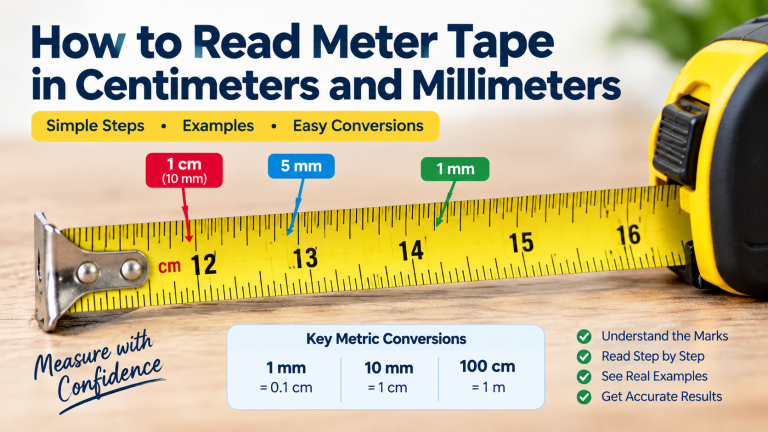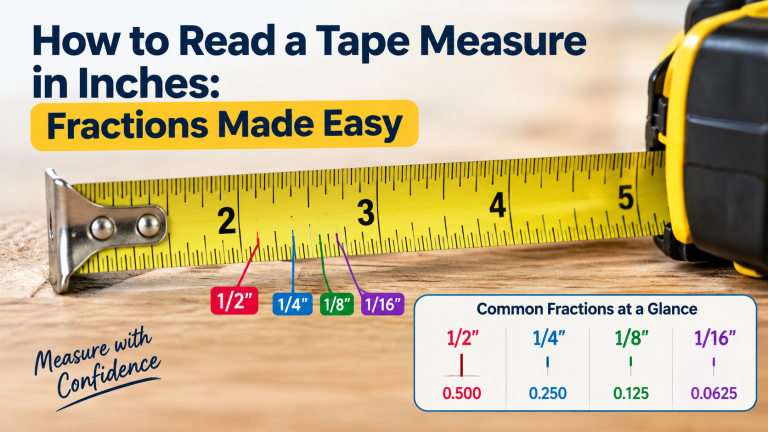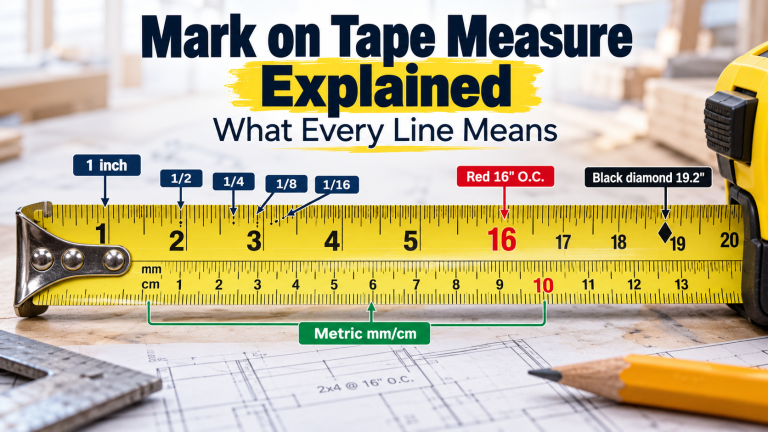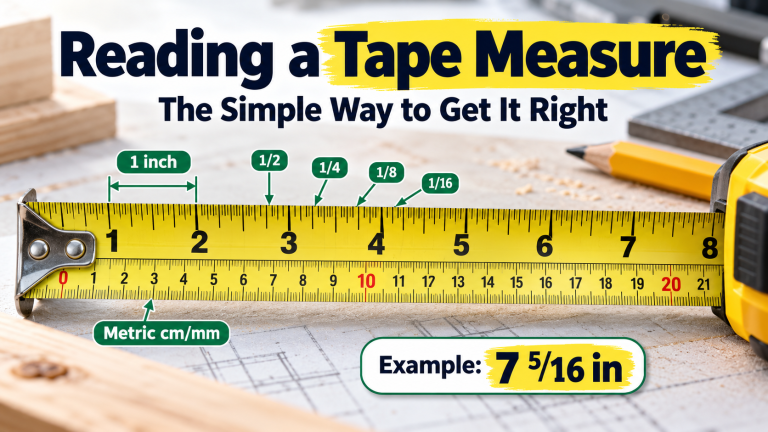
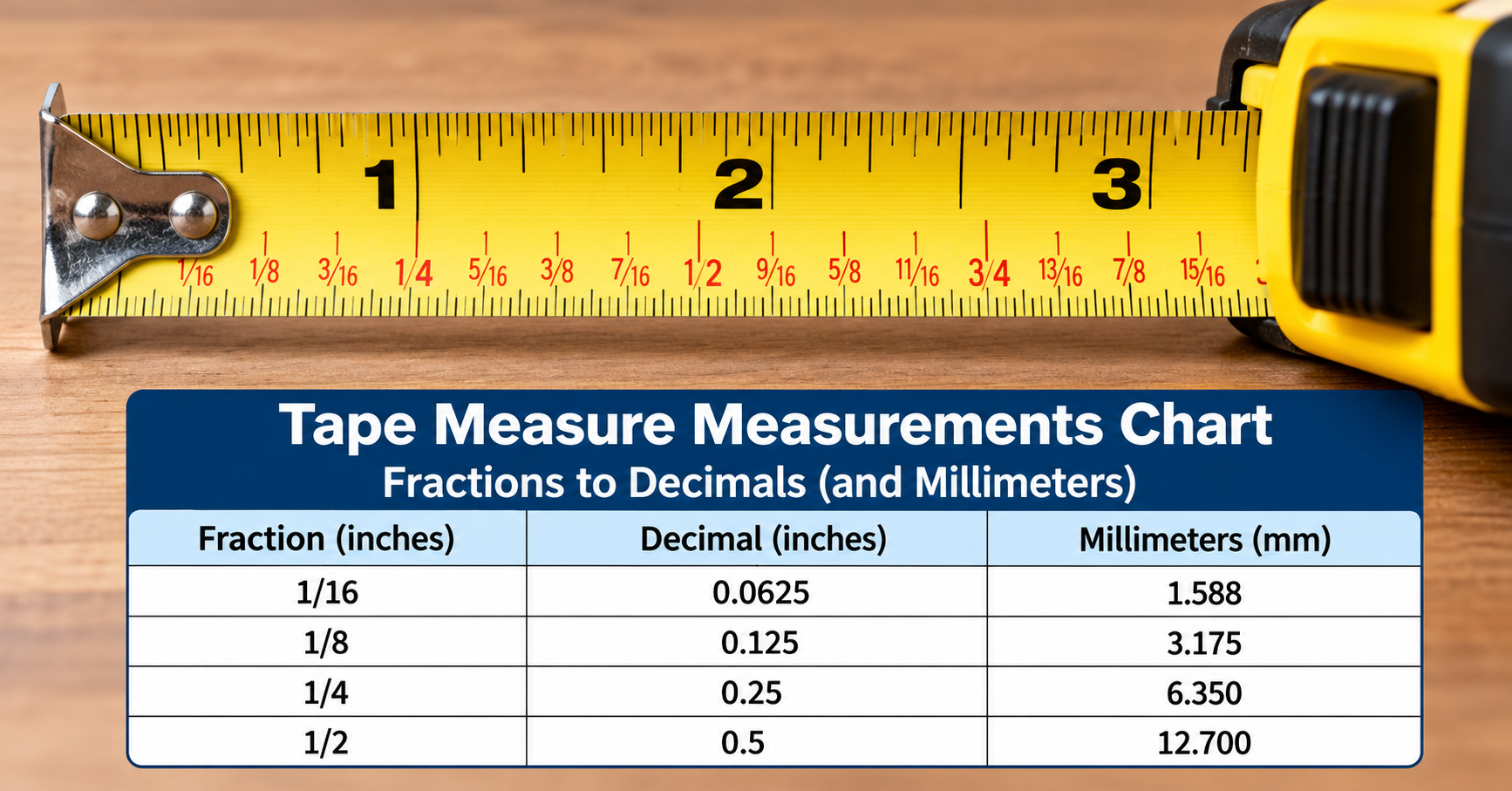
A tape measure measurements chart converts inch fractions into decimal inches and millimeters (mm). For example, 1/16 inch equals 0.0625 inches or 1.5875 mm, while 1/2 inch equals 0.5 inches or 12.7 mm. The key conversion is simple: 1 inch = exactly 25.4 mm.
The chart you need depends on the smallest marks on your tape measure. Some tapes show 1/16-inch marks, while others include finer 1/32-inch divisions. This guide provides quick-reference charts down to 1/64 inch, worked conversions, and tips for avoiding measurement errors.
Tape Measure Measurements Chart: 1/16-Inch Fractions
A tape measure measurements chart shows the decimal and metric value of each fractional inch mark. The 1/16-inch chart divides one inch into 16 equal parts. It covers the common fractional measurements used for furniture, home projects, and basic construction.
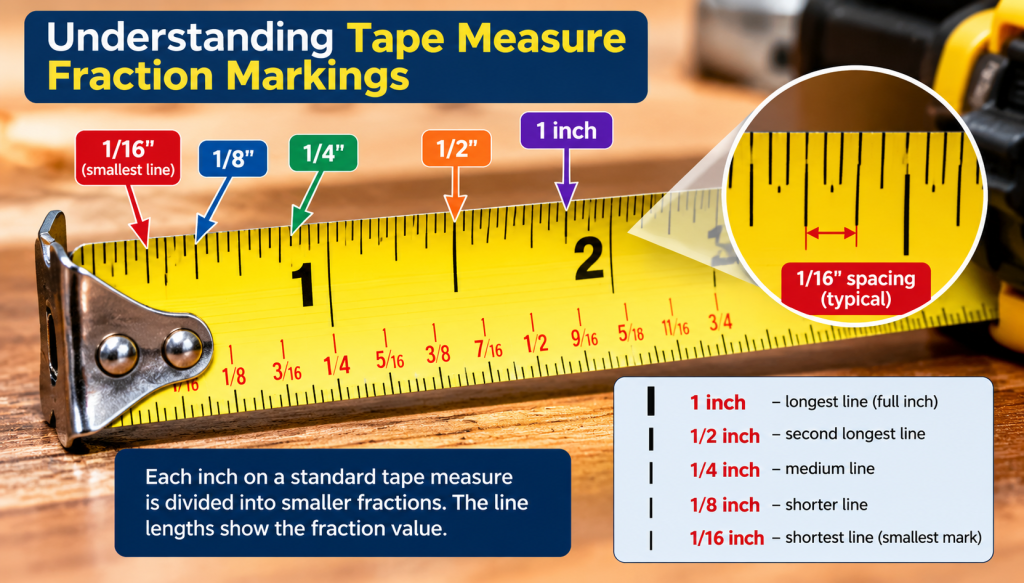
Use this chart whenever your tape shows 16 equal divisions between two consecutive inch numbers.
| Fraction (inches) | Decimal (inches) | Millimeters (mm) |
|---|---|---|
| 0 | 0 | 0.000 |
| 1/16 | 0.0625 | 1.588 |
| 1/8 | 0.125 | 3.175 |
| 3/16 | 0.1875 | 4.763 |
| 1/4 | 0.25 | 6.350 |
| 5/16 | 0.3125 | 7.938 |
| 3/8 | 0.375 | 9.525 |
| 7/16 | 0.4375 | 11.113 |
| 1/2 | 0.5 | 12.700 |
| 9/16 | 0.5625 | 14.288 |
| 5/8 | 0.625 | 15.875 |
| 11/16 | 0.6875 | 17.463 |
| 3/4 | 0.75 | 19.050 |
| 13/16 | 0.8125 | 20.638 |
| 7/8 | 0.875 | 22.225 |
| 15/16 | 0.9375 | 23.813 |
| 1 | 1 | 25.400 |
Chart basis: The international inch is defined as exactly 25.4 mm, according to the National Institute of Standards and Technology (NIST).
The decimal-inch values are exact. Millimeter values are rounded to three decimal places for easier reference. The fractions are mathematical divisions of an inch, not separate accuracy standards for tape measures.
For longer measurements, add the whole inches to the fraction. For example, 6 3/8 inches means six full inches plus another 3/8 inch.
Measuring Tape With Fractions: 1/32-Inch Chart
A measuring tape with fractions may include marks smaller than 1/16 inch. A 1/32-inch division is half the size of a 1/16-inch division. These finer markings help when a project needs a smaller measurement step.
This chart lists only the odd-numbered 1/32 fractions. The even-numbered ones simplify to fractions already shown in the 1/16-inch chart.
| Fraction (inches) | Decimal (inches) | Millimeters (mm) |
|---|---|---|
| 1/32 | 0.03125 | 0.794 |
| 3/32 | 0.09375 | 2.381 |
| 5/32 | 0.15625 | 3.969 |
| 7/32 | 0.21875 | 5.556 |
| 9/32 | 0.28125 | 7.144 |
| 11/32 | 0.34375 | 8.731 |
| 13/32 | 0.40625 | 10.319 |
| 15/32 | 0.46875 | 11.906 |
| 17/32 | 0.53125 | 13.494 |
| 19/32 | 0.59375 | 15.081 |
| 21/32 | 0.65625 | 16.669 |
| 23/32 | 0.71875 | 18.256 |
| 25/32 | 0.78125 | 19.844 |
| 27/32 | 0.84375 | 21.431 |
| 29/32 | 0.90625 | 23.019 |
| 31/32 | 0.96875 | 24.606 |
For example, 8/32 simplifies to 1/4 inch. Both represent exactly 0.25 inches or 6.35 mm.
Not every tape measure uses the same level of fractional detail. Some tapes stop at 1/16 inch, while others include smaller 1/32-inch markings for finer measurements. Before using values from this chart, check the smallest printed division on your tape to understand which fractions you can read directly and which would require estimation.
Tape Measure Chart for 1/64-Inch Measurements
A 1/64-inch mark divides an inch into 64 equal parts. This is useful for converting fine fractional dimensions found in workshop notes, technical drawings, and some precision measurement tasks.
The following chart includes the odd 1/64 fractions. Even 1/64 fractions simplify to values in the previous two charts. Many ordinary tape measures do not have separate 1/64-inch markings.
| Fraction (inches) | Decimal (inches) | Millimeters (mm) |
|---|---|---|
| 1/64 | 0.015625 | 0.397 |
| 3/64 | 0.046875 | 1.191 |
| 5/64 | 0.078125 | 1.984 |
| 7/64 | 0.109375 | 2.778 |
| 9/64 | 0.140625 | 3.572 |
| 11/64 | 0.171875 | 4.366 |
| 13/64 | 0.203125 | 5.159 |
| 15/64 | 0.234375 | 5.953 |
| 17/64 | 0.265625 | 6.747 |
| 19/64 | 0.296875 | 7.541 |
| 21/64 | 0.328125 | 8.334 |
| 23/64 | 0.359375 | 9.128 |
| 25/64 | 0.390625 | 9.922 |
| 27/64 | 0.421875 | 10.716 |
| 29/64 | 0.453125 | 11.509 |
| 31/64 | 0.484375 | 12.303 |
| 33/64 | 0.515625 | 13.097 |
| 35/64 | 0.546875 | 13.891 |
| 37/64 | 0.578125 | 14.684 |
| 39/64 | 0.609375 | 15.478 |
| 41/64 | 0.640625 | 16.272 |
| 43/64 | 0.671875 | 17.066 |
| 45/64 | 0.703125 | 17.859 |
| 47/64 | 0.734375 | 18.653 |
| 49/64 | 0.765625 | 19.447 |
| 51/64 | 0.796875 | 20.241 |
| 53/64 | 0.828125 | 21.034 |
| 55/64 | 0.859375 | 21.828 |
| 57/64 | 0.890625 | 22.622 |
| 59/64 | 0.921875 | 23.416 |
| 61/64 | 0.953125 | 24.209 |
| 63/64 | 0.984375 | 25.003 |
For accurate work at this scale, consider a suitable digital caliper rather than estimating tiny gaps between tape markings.
Note: Three decimal places in the metric chart do not mean a standard tape measure is accurate to 0.001 mm. They show rounded mathematical conversions only.
How to Use a Tape Measure Measurements Chart
Before using a conversion chart, you need to understand exactly where your measurement falls on the tape. Start by finding the whole-inch number, then identify the fractional mark that lines up with the object’s endpoint.
Once you know the correct fraction, you can use the chart to find its decimal-inch or millimeter equivalent without unnecessary calculations.
A conversion chart becomes more useful when you can confidently read measurements from the tape itself. If you are unsure where to position the hook, how to follow the numbered scale, or which line represents your measurement, review the basic tape measure reading process first.
Understanding these fundamentals will help you choose the correct fraction before converting it.
Here are two worked examples using different tape divisions.
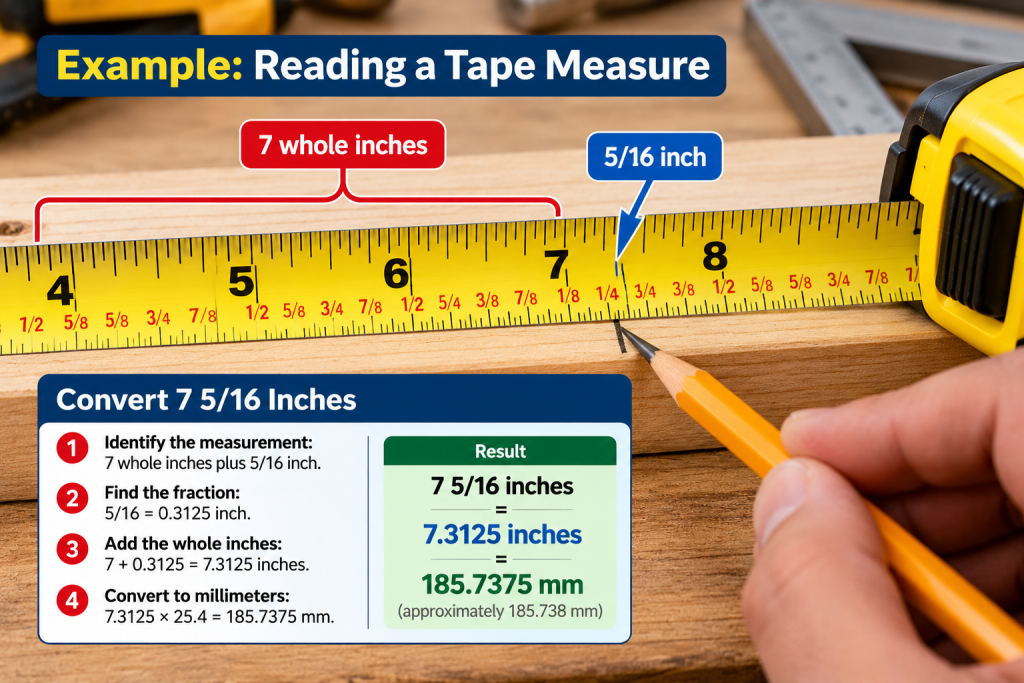
Example 1: Convert 7 5/16 Inches
- Identify the measurement: The tape reads 7 whole inches plus 5/16 inch.
- Find the fraction: The chart gives 5/16 = 0.3125 inch.
- Add the whole inches: 7 + 0.3125 = 7.3125 inches.
- Convert to millimeters: 7.3125 × 25.4 = 185.7375 mm.
Answer: 7 5/16 inches = 7.3125 inches = 185.7375 mm (approximately 185.738 mm).
Example 2: Convert 3 13/32 Inches
- Read the tape: The measurement is 3 whole inches plus 13/32 inch.
- Check the 1/32 chart: 13/32 = 0.40625 inch.
- Combine the values: 3 + 0.40625 = 3.40625 inches.
- Convert to millimeters: 3.40625 × 25.4 = 86.51875 mm.
Answer: 3 13/32 inches = 3.40625 inches = 86.51875 mm (approximately 86.519 mm).
Always record the whole-inch portion. A fraction alone is only the distance beyond the previous whole-inch mark.
Convert Inches to Millimeters Without a Chart
You can calculate a conversion even when the fraction is missing from the table. Divide the top number of the fraction by its bottom number to get decimal inches, then multiply by 25.4 to get millimeters.
Use these two formulas:
Decimal inches = Numerator ÷ Denominator
Millimeters = Decimal inches × 25.4
A numerator is the number above the fraction line. A denominator is the number below it.
For example, converting 2 3/4 inches:
So, 2 3/4 inches = 69.85 mm.
To convert millimeters back into inches, divide by 25.4.
For example:
19.05 mm ÷ 25.4 = 0.75 inch = 3/4 inch.
For an awkward value such as 42 mm:
42 ÷ 25.4 = 1.653543… inches.
Rounded to the nearest 1/32 inch, that is approximately 1 21/32 inches. It is an approximation because 42 mm does not fall exactly on that fractional mark.
Keep the unrounded value during calculations and round only at the end. This avoids adding unnecessary rounding errors.
Why Actual Tape Measurements Can Differ
A correct fraction chart does not guarantee a correct physical measurement. The chart describes ideal distances. The tape, surface, and measuring method determine how closely your reading matches reality.
End-hook movement: The metal hook on many retractable tape measures is designed to move slightly. It shifts outward when hooked over an edge and inward when pressed against a surface, helping account for the hook’s thickness. A bent or damaged hook can introduce zero error, meaning the tape does not start at the correct measuring point.
Parallax: This means viewing a mark from an angle rather than directly above it. Looking straight down helps prevent reading the wrong line.
Blade wear and bends: A stretched, kinked, twisted, or worn tape may not lie correctly against the measured surface. Keep it straight and supported.
Temperature: Metal tapes expand or contract as temperature changes. This effect is usually small for short household measurements, but it can matter over long distances or where tight tolerances are required.
Reading resolution: On a tape marked every 1/16 inch, rounding a reading to the nearest mark creates a possible rounding difference of up to 1/32 inch, or about 0.794 mm. This is only the mathematical rounding limit, not the tape’s total accuracy specification.
How to Check Your Tape at Home
Place the tape alongside a reliable ruler or reference scale and compare the 1-inch, 6-inch, and 12-inch marks (25.4, 152.4, and 304.8 mm). Repeat each measurement with the blade flat and straight.
Also compare measurements made with the hook pulled against an outside edge and pushed against an inside reference. If they disagree, inspect the hook and check the manufacturer’s guidance.
Do not try to remove the hook’s normal sliding movement. If it is damaged or readings repeatedly disagree, use a verified measuring tool or replace the tape.
Common Mistakes When Reading Tape Measure Fractions
Small reading errors can affect cutting, fitting, and assembly. These habits help you get more consistent results without making simple measurements complicated.
- Confusing 1/8 with 1/16: The denominator matters. One eighth is 0.125 inch, while one sixteenth is only 0.0625 inch.
- Missing the whole-inch number: A measurement of 4 3/8 inches is not the same as 3/8 inch. Write both parts clearly.
- Counting every mark as 1/16: First check whether the tape has 1/16-inch or 1/32-inch divisions. Some tapes also carry metric marks.
- Reading the printed number instead of the line: The actual measurement comes from the tick mark, not the center of the printed numeral.
- Rounding too early: Convert the full fraction before rounding the metric answer. Keep more digits when further calculations are needed.
- Assuming the chart proves accuracy: A 1/64-inch conversion does not mean your tape can reliably measure to that resolution.
- Ignoring the starting point: Check that the hook is seated correctly and the tape begins at the intended edge. If necessary, start at a clear whole-inch mark and subtract that starting distance from your final reading.
For further instructions on reading mark lengths and identifying hook problems, use a dedicated tape-reading or measuring-tool maintenance guide.
Tape Measure Measurements Chart FAQs
These answers cover common questions about tape fractions, decimal values, and millimeter conversions.
1. What do the small lines on a tape measure mean?
On an imperial tape measure, the small lines divide each inch into fractions such as 1/2, 1/4, 1/8, and 1/16. Some tapes have finer 1/32-inch marks. Check the smallest division on your tape.
2. What is 1/16 inch in decimal and millimeters?
One sixteenth of an inch is exactly 0.0625 inches or 1.5875 mm. Rounded to three decimal places, it is 1.588 mm.
3. Is 5/32 inch the same as 5/16 inch?
No. A 5/32-inch measurement equals 0.15625 inches or 3.96875 mm, while 5/16 inch equals 0.3125 inches or 7.9375 mm.
4. How do I convert 2 3/8 inches to millimeters?
Change 3/8 to 0.375, then add 2 to get 2.375 inches. Multiply 2.375 by 25.4 to get exactly 60.325 mm.
5. Can a tape measure show 1/64-inch measurements?
Some specialized measuring scales include 1/64-inch divisions, but many ordinary retractable tapes do not. Check the markings and manufacturer specifications before assuming the tool can resolve that fraction.
Final Thoughts
A tape measure measurements chart gives you a quick way to turn fractional inches into decimal inches and millimeters. Start with the 1/16-inch chart for common marks, then use the finer charts when the fraction requires it. Remember that every conversion is based on exactly 25.4 mm per inch.
For practical measurements, the condition of your tool and the way you read it matter as much as the chart. Use the fraction your tape actually shows, calculate with full values, and round the answer to a level that makes sense for your project.