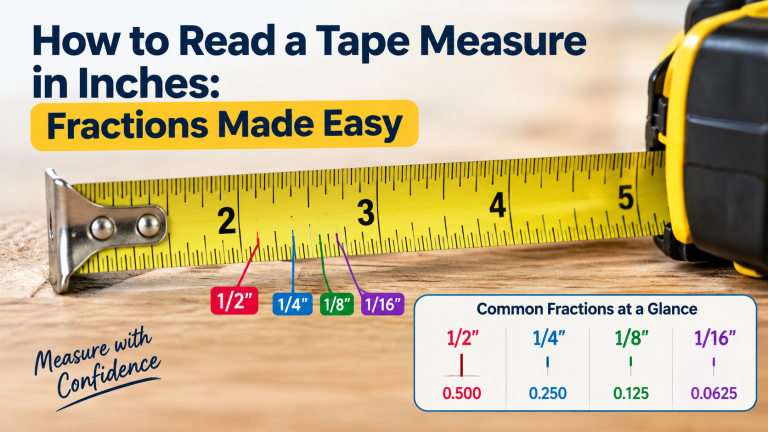
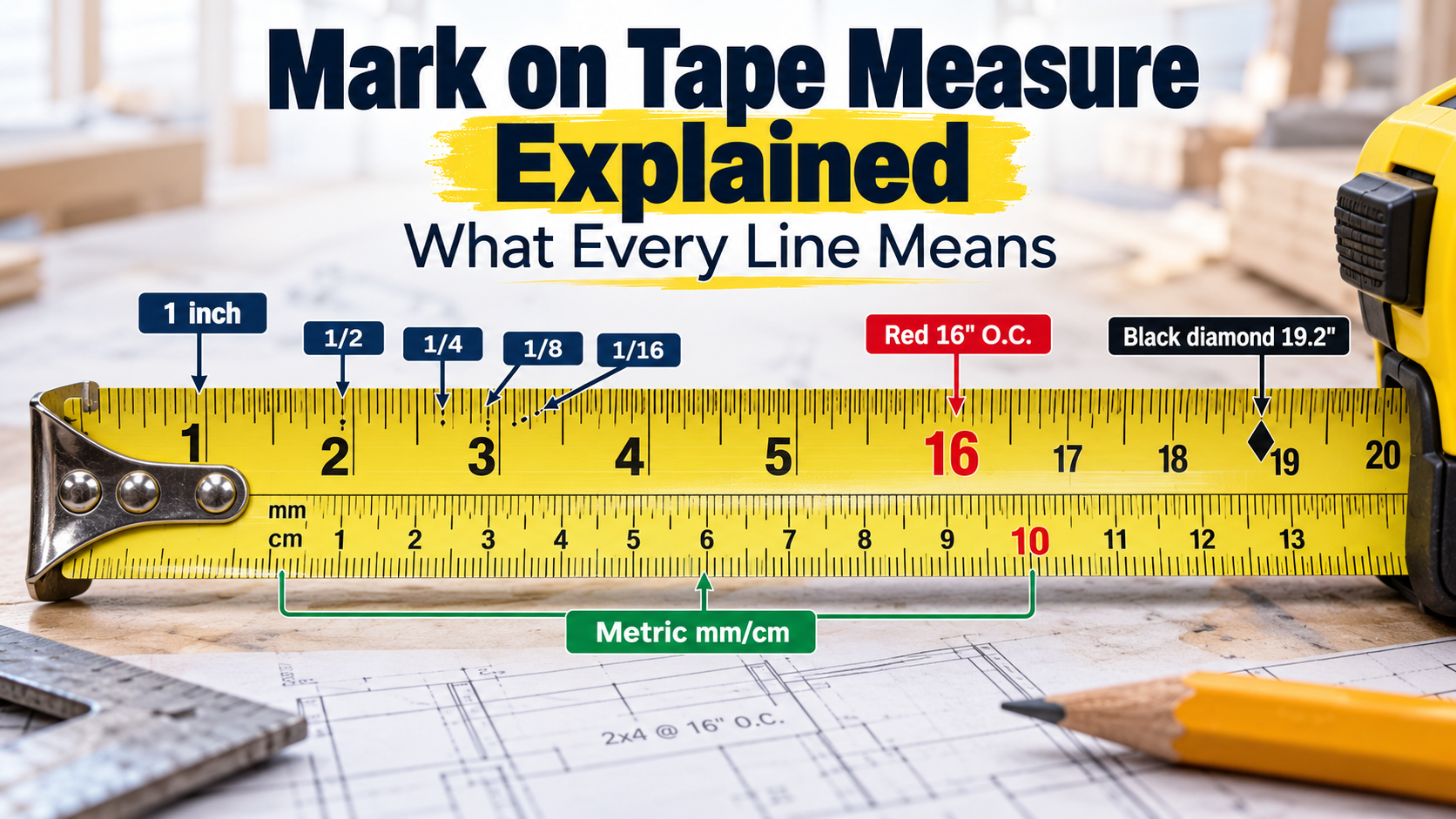
A mark on tape measure shows a measurement or a special layout position. On a common inch tape, the smallest lines usually represent 1/16 inch (1.59 mm). Red numbers often mark 16-inch (406.4 mm) spacing, while black diamonds mark 19.2-inch (487.68 mm) spacing. The longer lines show whole inches and larger fractions.
The exact markings depend on your tape measure. Some use inches, some use millimeters, and others display both. This guide explains the lines, numbers, diamonds, and symbols so you can understand what you are looking at and avoid common reading mistakes.
What Does Each Mark on a Tape Measure Mean?
A tape measure mark is a printed line or symbol that helps you identify a length or spacing. Regular lines divide the scale into smaller units, while special symbols help with layout work. The length and position of each line tell you what it means.
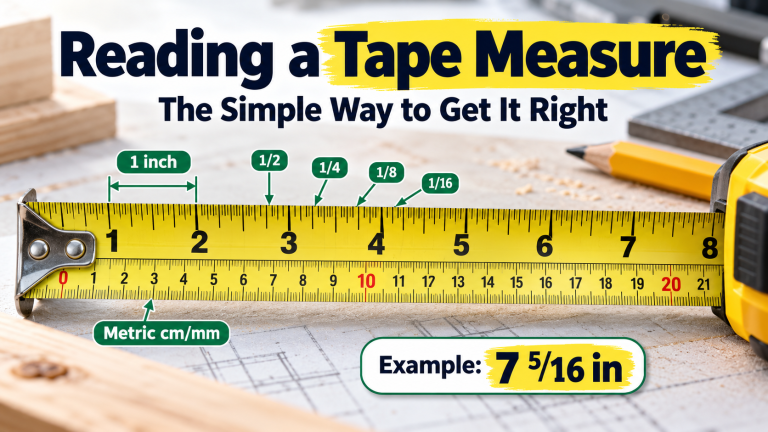
On a typical imperial tape, the numbered inch marks are the longest. The lines between them become shorter as the measurement gets smaller.
Understanding the different line lengths
Each inch is commonly divided into 16 equal parts. These parts are called increments, meaning the smallest marked steps on the scale.
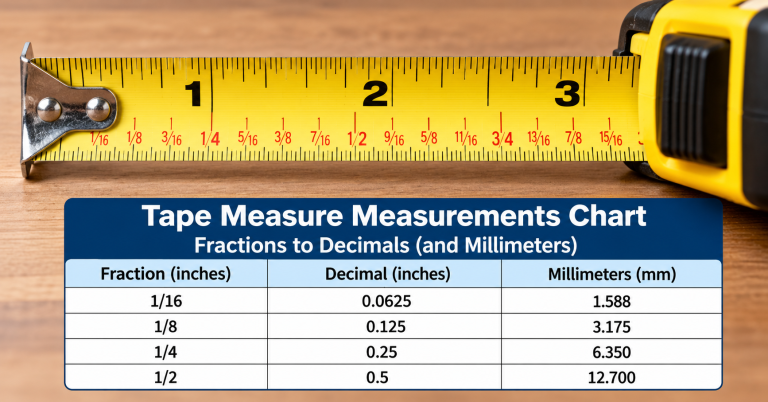
| Tape mark | How to recognize it | Metric equivalent |
|---|---|---|
| 1 inch | Longest line, usually numbered | 25.4 mm |
| 1/2 inch | Long line halfway between inches | 12.7 mm |
| 1/4 inch | Medium-long line | 6.35 mm |
| 1/8 inch | Shorter line | 3.175 mm |
| 1/16 inch | Usually the shortest line | 1.5875 mm |
| 1/32 inch | Extra-fine line on some tapes | 0.79375 mm |
Reference: U.S. customary inch divisions and SI metric conversion, using 1 inch = 25.4 mm exactly. Line lengths and available graduations vary by manufacturer.
Each fractional tick mark represents a specific distance, but that measurement may sometimes need to be written in another format. For instance, a construction drawing might use fractional inches while a calculation requires decimal inches or millimeters.
Instead of converting each fraction manually, you can use our fraction-to-decimal conversion tables to look up the corresponding values quickly.
For example, between the 2-inch and 3-inch marks:
A tape divided into sixteenths has 16 spaces per inch, but only 15 interior tick marks. The next whole-inch line completes the final space.
Quick rule: The longer the line, the larger the fraction it usually represents.
How to Read Tick Marks on a Tape Measure
To read tick marks on a tape measure, find the last whole-inch number before the end of the object. Then count the smaller divisions to the exact point. Add that fraction to the whole number.
A tick mark is simply a short line showing a division of a measurement scale.
Recognizing the different tick-mark lengths is the first step toward understanding an imperial measuring tape. Once you can distinguish half-inch, quarter-inch, eighth-inch, and sixteenth-inch lines, you can use their positions to determine a measurement.
For practical examples showing how these fractions are read between whole-inch numbers, follow our step-by-step imperial fraction reading tutorial.
Example 1: Reading 4 5/16 inches
Assume you have a tape divided into sixteenths. The edge of an object falls on the fifth 1/16-inch position after the 4-inch mark.
- Find the 4-inch mark.
- Count five 1/16-inch spaces toward the 5-inch mark. Include longer fraction lines when counting.
- Calculate the fraction: 5 × 1/16 = 5/16.
- Add it to the whole inches: 4 + 5/16 = 4 5/16 inches.
In decimal inches:
4 + 5 ÷ 16 = 4.3125 inches.
In millimeters:
4.3125 × 25.4 = 109.5375 mm, or about 109.54 mm.
Example 2: Reading 7 3/4 inches
Suppose the edge of a shelf lands on the three-quarter mark after the number 7.
- Locate the 7-inch mark.
- Find the 1/2-inch line, then the next 1/4-inch division.
- Add the fraction: 7 + 3/4 = 7 3/4 inches.
The decimal measurement is:
7 + 0.75 = 7.75 inches.
The metric equivalent is:
7.75 × 25.4 = 196.85 mm.
You can use the same method for 1/8, 3/8, 5/8, 7/8, and other fractions.
When measuring, follow the line itself rather than the printed number. The number may sit beside the exact measurement position.
For a practical explanation of the entire process, see our complete tape-reading walkthrough, which covers these essential measuring steps.
What Do the Red Numbers and Black Diamonds Mean?
Some marks on a tape measure are designed for construction layout instead of ordinary length readings. Red numbers and black diamonds are common examples. They show repeated spacing positions for framing.
Not every tape includes these symbols, and their appearance can vary.
| Special mark | Meaning | Typical use |
|---|---|---|
| Red 16, 32, 48, 64 | Every 16 inches (406.4 mm) | Framing layout |
| Black diamond | Every 19.2 inches (487.68 mm) | Certain joist and truss layouts |
| Foot label or symbol | Every 12 inches (304.8 mm) | Quick feet-and-inches reading |
Why are some numbers red every 16 inches?
The red marks commonly highlight 16-inch-on-center spacing.
“On center” means the distance from the center of one framing member to the center of the next.
For example, if a framing plan calls for 16-inch spacing, the repeated layout positions are:
16, 32, 48, 64, and 80 inches.
Three 16-inch spaces equal:
16 × 3 = 48 inches = 4 feet.
This spacing works with common 4-foot-wide building panels.
However, a red 16-inch mark does not prove that studs inside an existing wall follow that spacing. Openings, corners, and framing changes can affect their positions.
What do black diamond marks mean?
Black diamonds are often called truss marks. On many imperial construction tapes, they appear at intervals of 19.2 inches.
They help lay out certain engineered joists and roof or floor framing systems.
The spacing comes from dividing an 8-foot length into five equal sections.
8 feet × 12 = 96 inches.
96 ÷ 5 = 19.2 inches per section.
That equals 487.68 mm between positions.
An important detail is that 19.2 inches is not exactly 19 3/16 inches.
- 19.2 inches = 19.2000 inches.
- 19 3/16 inches = 19.1875 inches.
- Difference = 0.0125 inch, or 0.3175 mm.
This explains why the diamond can appear very close to a regular fraction line without representing that exact fraction.
According to STANLEY’s explanation of black diamond markings, these symbols support engineered joist spacing and layout over 8-foot sections.
Do not select framing spacing just because your tape shows a diamond. Follow the construction drawings and applicable structural requirements.
What Do Metric Marks and Other Symbols Mean?
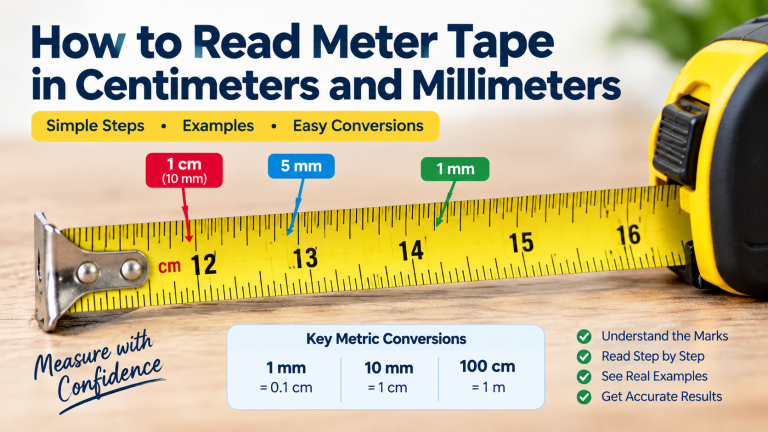
Metric tape measures display measurements using millimeters, centimeters, and sometimes meters. Their markings follow a decimal system, with ten millimeters making one centimeter and one hundred centimeters making one meter.
Knowing how these divisions are arranged helps you recognize metric markings and avoid confusing them with fractional-inch lines on a dual-scale tape.
On many metric tapes, each short division is 1 millimeter.
| Metric mark | Distance | How it appears |
|---|---|---|
| 1 mm | 0.1 cm | Smallest regular line |
| 5 mm | 0.5 cm | Often a medium-length line |
| 10 mm | 1 cm | Longer line, often numbered |
| 100 mm | 10 cm | Often has a larger number or highlight |
Reference: International System of Units (SI). Printed colors, numbering, and line lengths are not identical on every tape.
For example, suppose an object’s edge falls 7 mm after the 12 cm mark.
The reading is:
12 cm = 120 mm.
120 + 7 = 127 mm, or 12.7 cm.
Because 1 inch equals exactly 25.4 mm:
127 ÷ 25.4 = 5 inches.
What about tapes with two different number scales?
Dual-scale tapes display both imperial and metric units.
One edge might show inches divided into fractions, while the other shows centimeters divided into millimeters.
Before reading a number, check which scale it belongs to. The number 10 on the inch side means 254 mm, while 10 cm means 100 mm.
Other markings you may find include:
The printed case dimension is not a tick mark on the blade. Use it only when the manufacturer provides the correct measurement method.
Some tapes also highlight fractions or metric spacing with different colors. Treat those as reading aids unless the manufacturer identifies another purpose.
Why Actual Tape Measurements Can Differ
Even when you understand every line on a tape measure, your results may not be exact. A clear mark does not guarantee a correct measurement.
Small differences can come from tool wear, the hook position, viewing angle, temperature, or measuring technique.
The end hook and zero error
The metal hook at the end of many retractable tapes is designed to move slightly.
When you pull it over the edge of a board, the hook moves outward. When you press it against a surface, it moves inward. This motion compensates for the thickness of the hook.
A damaged hook can create zero error, meaning the measurement starts from the wrong position.
Normal designed movement is not necessarily a problem. A bent hook or badly worn mounting holes may be.
Parallax and poor alignment
Parallax is a reading error caused by viewing a scale from an angle.
If your eye is not directly above the mark, you may select the wrong short line.
A bent or twisted blade can also make the edge of an object appear to line up with the wrong position.
Temperature can affect the length of a metal tape, especially during long or highly precise measurements. For everyday short measurements, hook condition and user technique are often more noticeable concerns.
How to check your tape at home
You can make a basic comparison without specialized equipment.
- Place the tape flat against a reliable steel ruler.
- Align the starting points carefully.
- Compare known positions, such as 10 inches (254 mm) and 20 inches (508 mm), if the ruler is long enough.
- Repeat using both the hooked and pushed-against positions.
- Check for bent metal, damaged printing, or inconsistent readings.
This is a practical check, not a certified calibration.
If you find a consistent difference, inspect the hook and compare another reliable measuring tool. For critical measurements, use equipment with suitable verified accuracy.
Common Mistakes With Marks on a Tape Measure
Most errors happen when people confuse similar-looking lines or ignore the starting position. A simple routine helps you avoid them.
Here are six mistakes worth checking.
- Treating every short line as 1/16 inch. The fraction depends on your tape’s graduation. Some tapes include 1/32-inch lines or additional fine markings.
- Counting only the shortest lines. Longer 1/4-inch and 1/2-inch lines are still part of the 1/16-inch sequence. Count every division when reading sixteenths.
- Confusing red numbers with a different unit. Red 16-inch labels usually highlight framing intervals. They do not change the length of an inch.
- Reading the diamond as an ordinary fraction. The 19.2-inch layout position is slightly different from 19 3/16 inches.
- Mixing inches and centimeters. On a dual-scale tape, check the unit before writing down the measurement.
- Ignoring hook damage or a tilted tape. Keep the blade straight, check the starting point, and look directly at the mark.
For an important fit, take the measurement twice. If the values differ, find the cause before cutting or assembling anything.
Frequently Asked Questions
These answers cover the tape measure markings that most often confuse beginners.
1. How many marks are in one inch on a tape measure?
A typical 1/16-inch tape has 16 equal spaces within one inch and 15 interior tick marks. The next whole-inch mark completes the sixteenth space. Some tapes include finer divisions.
2. What is the smallest line on a tape measure?
On many standard imperial tapes, the smallest line represents 1/16 inch, or about 1.59 mm. Some tapes show 1/32-inch divisions. Check the printed scale before assuming.
3. What does the red 16 mean on a tape measure?
It usually marks a 16-inch framing interval. These highlights help workers lay out positions at 16, 32, 48 inches, and so on.
4. What does the black diamond mean on a tape measure?
A black diamond commonly marks 19.2-inch spacing. This is used for certain joist and truss layouts because five equal 19.2-inch spaces add up to 8 feet.
5. Why does my tape measure have different numbers on each side?
It may have both imperial and metric scales. One side can show inches while the other shows centimeters. Look for unit labels to identify the correct reading.
Final Thoughts
Every mark on a tape measure has a purpose. Long lines show whole units and larger fractions, short lines show smaller increments, and special markings such as red numbers and black diamonds help with repeated layout spacing.
You do not need to memorize every fraction immediately. Start by recognizing the main lines, check the units, and practice reading a few measurements. With a straight blade and a working hook, you can make more consistent measurements for everyday projects.