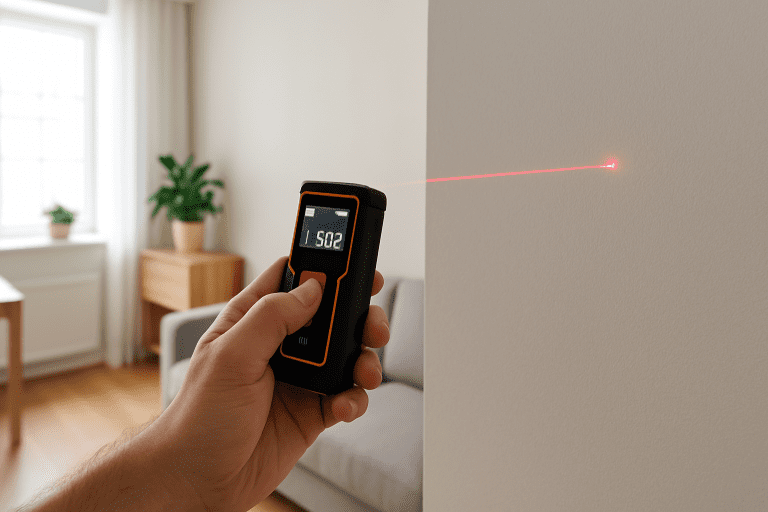
I used to assume the accuracy of laser measuring tools was fixed, like it was printed on the box and that was that. Then I compared readings from three different tools against a steel tape on the same wall, and got three slightly different numbers. That sent me down a rabbit hole of figuring out what actually changes accuracy and what doesn’t.
If you’ve ever wondered whether the number on your laser tool’s screen is something you can trust for a real project, or just a rough estimate, this is what I learned from testing it against known measurements and using it on actual job sites.
How Accurate Are Laser Measuring Tools Really
Most consumer laser measuring tools claim accuracy within about 1/16 inch over typical indoor distances. In my testing, that held up under good conditions, but “good conditions” is doing a lot of work in that sentence.
The stated accuracy on the box is a best-case number. Once you factor in distance, surface type, and how steady your hand is, real-world accuracy shifts a bit.
| Distance Measured | Typical Accuracy in Practice |
|---|---|
| Under 15 feet | Very close to manufacturer spec |
| 15 to 50 feet | Small drift, usually under 1/8 inch |
| Over 50 feet | Depends heavily on surface and lighting |
What Actually Affects the Reading
I expected the tool itself to be the main variable. It turns out the environment matters just as much, sometimes more.
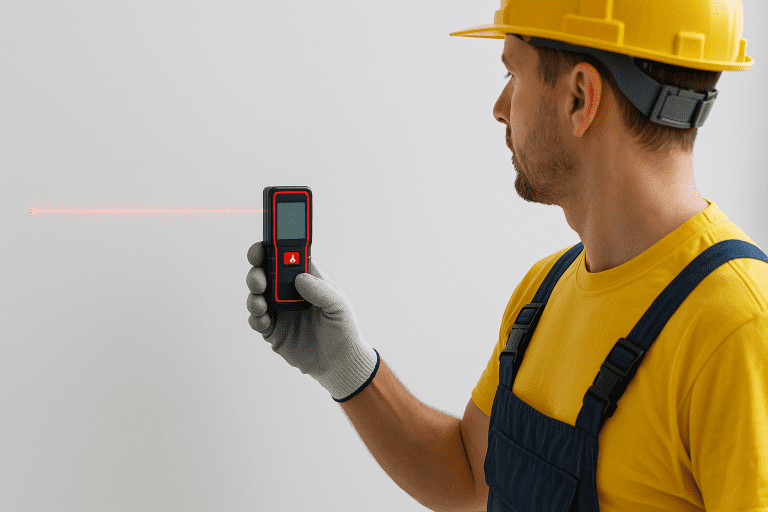
Temperature swings, humidity, and even the angle you’re holding the device at all nudge the reading slightly. None of these are dealbreakers on their own, but they stack.
| Factor | Effect on Accuracy |
|---|---|
| Holding the tool at a slight angle | Adds small but real error over distance |
| Extreme heat or cold | Can affect internal sensor calibration |
| Vibration or unsteady grip | Causes minor inconsistency between readings |
| Dust or smudges on the lens | Scatters the beam, reduces precision |
Where I Got Burned by Overconfidence
On one job, I trusted a single laser reading for cutting trim without double-checking it. The wall had a slight bow I hadn’t noticed, and the laser measured to a high point instead of the average surface. The trim came up short by almost half an inch.
That mistake taught me that accuracy isn’t just about the tool. It’s about what you’re pointing it at and whether that surface is actually flat.
Class 2 vs Class 3R Lasers and Why It Matters
Laser measuring tools are usually built with Class 2 or Class 3R lasers, and this isn’t just a safety label. Class 3R lasers tend to hold a visible dot better over longer distances, which indirectly helps accuracy because you can actually confirm where the beam landed.
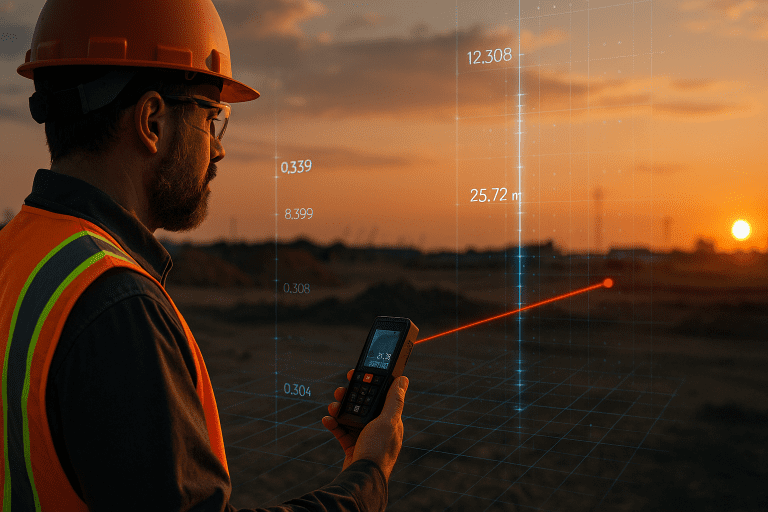
If you’re often measuring long hallways or outdoor spaces, checking the laser class before buying can save you some squinting later.
Comparing Laser Tools to Traditional Tape Measures
People often ask whether a laser tool is more accurate than a tape measure, and the honest answer is: it depends on who’s using it. A steady, careful person with a tape measure can be just as precise over short distances.
| Comparison Point | Laser Tool | Tape Measure |
|---|---|---|
| Speed for long distances | Much faster | Slower, needs two people often |
| Consistency across multiple users | Higher, less user error | Varies more by technique |
| Performance on uneven surfaces | Can be tricked by bowed walls | Physically follows the surface |
| Battery dependency | Yes | No |
Common Myths About Accuracy
A lot of assumptions about these tools don’t hold up once you actually test them.
| Myth | Reality |
|---|---|
| More expensive tools are always more accurate | Price often reflects features, not core accuracy |
| Accuracy never changes once calibrated | Drops or temperature extremes can throw off calibration |
| One reading is always enough | A second reading catches angle or surface errors |
How I Test Accuracy Before a Big Project
I started keeping a known reference length, like a marked two-by-four, and measuring it with the laser tool before trusting it on something important. If the reading matches, I move forward. If it’s off, I know to recalibrate or switch tools.
This habit has caught a slightly miscalibrated tool twice, both times before it could cost me material.
| Situation | Quick Accuracy Check |
|---|---|
| Before a big cutting job | Measure a known-length object first |
| After dropping the tool | Re-test against a reference before using it |
| Working outdoors | Compare a short reading against a tape measure |
Firmware, Calibration, and the Stuff Nobody Talks About
Some higher-end laser tools let you recalibrate through firmware updates, which most people never touch. I didn’t either, until a reading started drifting slightly after a year of regular use. A quick recalibration through the manufacturer’s app fixed it.
It’s not a step most reviews mention, but it’s worth checking if your tool has that option before assuming the hardware itself is failing.
Final Thoughts
The accuracy of laser measuring tools is genuinely good under normal conditions, but it’s not something to trust blindly on every job. Distance, surface flatness, lighting, and even how steady you hold the device all play a role in the final number.
My honest takeaway is that these tools earn their reputation for speed and convenience, but pairing them with a quick reference check before anything important is the habit that actually protects your accuracy. Once that became routine for me, I stopped second-guessing the numbers and started trusting them for the right reasons.