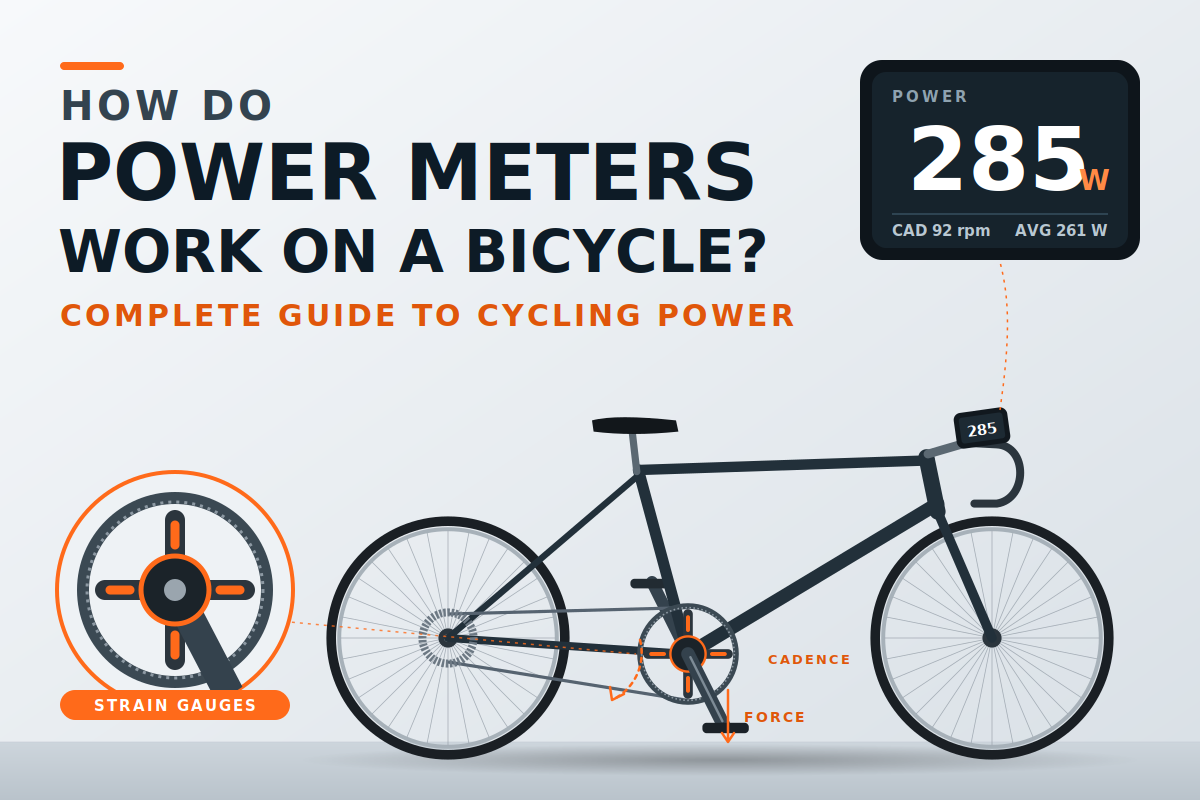
If you’ve ever looked at a cycling power meter and wondered how it knows your watts, the answer is more interesting than it seems. The meter does not directly feel “watts.” Instead, it measures the load created when you pedal and uses that data with crank speed to calculate power.
Most cycling power meters use tiny sensors called strain gauges. These sensors detect very small changes in a pedal, crank, spindle, or spider when you apply force. The electronics then turn that signal into torque and power data.
Once you understand this process, pedal, crank, and spider power meters become much easier to compare.
How Do Power Meters Work on a Bicycle?
A bicycle power meter measures the force you put into the drivetrain and calculates how quickly that work happens. The result is your power output, shown in watts.
The basic process looks like this:
Pedal force → tiny flex → strain gauge signal → torque → crank speed → watts
The important point is that the meter does not simply count how hard you push the pedal. It also needs to know how fast the crank is turning.
A hard push at a slow cadence and a hard push at a fast cadence won’t produce the same power. That’s why both force and rotation matter.
What Does a Bicycle Power Meter Actually Measure?
A power meter normally measures load or torque, then uses rotational speed to calculate power.
Think of torque as twisting force. When you push down on a bicycle pedal, you create a force that tries to turn the crank.
Cadence tells the meter how fast that crank is turning.
| Measurement | Simple meaning | Why it matters |
|---|---|---|
| Force | Your push on the pedal | Creates load |
| Torque | Twisting force on the crank system | Used to calculate power |
| Cadence | Crank speed | Shows how fast the system rotates |
| Power | Rate of doing mechanical work | Displayed in watts |
So when your bike computer shows 250 W, the meter has already processed several pieces of information to produce that number.
How Do Strain Gauges Measure Pedal Force?
The strain gauge is one of the key parts inside many power meters.
When you pedal, the part holding the sensor experiences a very small amount of deformation. You won’t normally see this movement with your eyes. It’s tiny, but the sensor can detect it.
A strain gauge changes its electrical resistance when it stretches or compresses. The power meter measures that change and uses it to work out the load.
Here’s the basic sequence:
- You push the pedal
- The crank, spindle, or spider takes the load
- The component flexes by a tiny amount
- The strain gauge detects the change
- Electronics turn the signal into useful data
This is why power meters need careful calibration. The sensor is working with very small physical changes.
How Does a Power Meter Turn Force Into Watts?
The power calculation is based on torque and angular velocity.
In simple terms:
Power = Torque × Angular Velocity
You don’t need to calculate this yourself. The power meter handles it many times during a ride.
Here’s what happens inside the system:
| Step | What the meter determines |
|---|---|
| 1 | Load on the sensor |
| 2 | Torque created by that load |
| 3 | Crank rotation speed |
| 4 | Mechanical power |
| 5 | Result in watts |
Cadence plays an important role here. If torque stays the same but the crank spins faster, power increases.
That’s why two riders can use similar force but produce different power.
Why Cadence Matters
Imagine pushing a heavy pedal with a slow cadence. Now imagine producing the same twisting force while spinning much faster.
The second effort can produce more power because you’re doing the work more quickly.
This is also why cyclists can change their power by changing both force and cadence.
Why Pedal Force Changes During Every Revolution
Your pedal force isn’t constant throughout a complete crank revolution.
At some crank positions, your leg can produce useful turning force more easily. At other positions, much of your force points in a direction that creates less rotation.
This matters because the power meter is not simply waiting for one large push. It samples the changing load as you pedal.
Think about a clock face:
The meter processes these changing forces to calculate your overall power.
That gives you a much better picture than simply knowing how hard you pushed once.
Where Is a Bicycle Power Meter Installed?
Power meters can measure the rider’s input at different points on the bike.
The most common designs are pedal, crank, and spider power meters.
| Power meter type | Sensor location | Main advantage |
|---|---|---|
| Pedal | Pedal or spindle | Easy to move between compatible bikes |
| Crank-arm | Crank arm | Often a simple entry point |
| Spider | Crank spider | Measures combined crank input |
| Integrated crank | Crank system | Clean integrated setup |
| Rear hub | Rear hub | Measures power near the rear wheel |
The measurement location matters because power can change as energy moves through the drivetrain.
For example, a meter near the pedals measures your input before drivetrain losses. A meter farther down the drivetrain measures power after some of those losses.
How Do Pedal Power Meters Work?
A pedal power meter puts its sensors in the pedal or pedal spindle area.
That’s a useful location because your force enters the bicycle through the pedals. The meter can detect the load close to where you apply it.
Pedal meters are often attractive if you have more than one bike.
Main advantages
The main issue is compatibility. You need to check the pedal system, cleats, crank clearance, and bike setup before buying.
How Do Crank and Spider Power Meters Work?
Crank-arm power meters measure load in the crank arm. Spider power meters measure load around the spider where the chainrings attach.
The two designs measure power at different points, so they aren’t exactly the same thing.
A crank-arm meter can be attractive because it may offer a lower-cost way to start training with power. A spider meter can measure the combined input from both legs without simply doubling one side.
| Feature | Crank-arm | Spider |
|---|---|---|
| Sensor location | Crank arm | Spider |
| Measurement | One side or both, depending on design | Combined crank input |
| Compatibility | Depends on crank | Depends on crankset |
| Transfer between bikes | Varies | Usually less convenient |
| Main appeal | Simpler entry | Total power measurement |
Always check the exact crank and drivetrain compatibility before buying either type.
Single-Sided vs. Dual-Sided Power Meters
This is one of the biggest differences to understand before buying a power meter.
A single-sided meter measures one leg. It then estimates total power, often by doubling the measured side.
That approach can work well for many riders. However, it assumes the measured side represents the other side reasonably well.
A dual-sided meter measures both sides separately.
The basic difference
For most riders, the important question isn’t simply “Which is better?” It’s whether separate left/right data is useful for your training.
What Happens to the Power Data After Measurement?
The strain gauges produce a very small electrical signal. The power meter’s electronics process that signal and turn it into useful measurement data.
The process then looks something like this:
- Sensors detect deformation
- Electronics process the sensor signal
- The meter determines torque
- Crank speed is measured
- Power is calculated
- The result is transmitted wirelessly
- Your bike computer or training app displays the data
Depending on the device, the power meter can send data to a cycling computer, smartwatch, phone, or indoor training platform.
This is how the number you see on a Garmin, Wahoo, or Zwift screen gets there.
Why Do Power Meters Need Calibration?
Power meters work with very small changes. That means the system needs a reliable baseline.
This is where zero offset becomes important.
Zero offset is the reading the meter expects when there is no rider load. Checking it helps the meter separate its baseline from the force you apply while riding.
It’s a good idea to follow the manufacturer’s instructions for calibration or zero-offset checks.
You may want to check it:
Calibration won’t make a poor meter perfect. It simply helps the sensor start from the correct baseline.
Why Do Two Power Meters Show Different Watts?
Two power meters can show different numbers even when you’re riding at the same effort.
That’s because they may measure at different points and use different sensor designs.
Other factors can also matter:
For example, a pedal meter and a rear-hub meter don’t measure power at the same point.
So don’t panic if two meters show a small difference. The important thing is to use a reliable meter consistently when tracking your own training.
How a Power Meter Helps in Real Cycling
Power becomes useful when you use it to control effort.
A power meter can help you avoid relying only on speed or heart rate. Speed changes with hills, wind, road surface, and other factors. Power gives you a more direct view of your mechanical effort.
| Cycling situation | How power can help |
|---|---|
| FTP test | Creates a training reference |
| Long climb | Helps control effort |
| Triathlon | Helps maintain steady pacing |
| Interval workout | Keeps efforts near target |
| Zwift workout | Tracks or controls training load |
| Long endurance ride | Helps prevent early overexertion |
Example: Pacing a Long Climb
Imagine you start a long climb at 320 watts because you feel fresh.
Five minutes later, fatigue starts to build. You may have to reduce your effort sharply near the top.
A power target can help you control that early surge. Instead of chasing speed, you can aim for a sustainable effort.
That’s one reason power meters are popular with racers and structured-training riders.
How Do You Know If You Need a Power Meter?
You don’t need a power meter just because you ride a bike.
It becomes more useful when you want structured data.
A power meter may make sense if:
You may not need one yet if:
For a new rider, learning pacing and riding consistently may matter more than adding another sensor.
Pedal vs. Crank vs. Spider Power Meter
If you’re ready to buy one, start with compatibility rather than the feature list.
Think about where you want the meter to measure and how often you’ll move it between bikes.
| Factor | Pedal | Crank | Spider |
|---|---|---|---|
| Easy to move | High | Medium | Low to medium |
| Measurement point | Pedal | Crank | Spider |
| Dual-sided options | Common | Available | Measures combined input |
| Bike compatibility | Pedal system | Crank dependent | Crankset dependent |
| Multiple bikes | Good choice | Depends on setup | Less convenient |
For a rider with two bikes, pedal power meters can be convenient. For a rider who wants a fixed setup, a crank or spider meter may make more sense.
There is no single best design for everyone.
Common Power Meter Mistakes to Avoid
A power meter can give useful data, but only if the setup is correct.
Avoid these common mistakes:
The best approach is simple. Pick a reliable system, set it up correctly, and use it consistently.
Frequently Asked Questions
Q01. How do power meters work on a bicycle?
Most cycling power meters use strain gauges to detect tiny changes in a pedal, crank, spindle, or spider. They use that load with crank speed to calculate power in watts.
Q02. Do bike power meters measure force or power?
Most power meters measure load or torque and then calculate power. They don’t directly sense watts as a single physical quantity.
Q03. How does a power meter calculate watts?
A power meter uses torque and angular velocity to calculate power. In simple terms, power equals torque multiplied by angular velocity.
Q04 Are pedal power meters accurate?
They can be accurate when properly installed and calibrated. Accuracy depends on the specific meter, its design, installation, temperature, and measurement conditions.
Q05. What is the difference between single-sided and dual-sided power meters?
A single-sided meter measures one leg and estimates total power. A dual-sided meter measures both legs separately.
Q06. Are crank or pedal power meters better?
Neither is always better. Pedal meters can be easier to move between bikes, while crank and spider systems may suit riders who want a fixed setup.
Q07. Do power meters work with Zwift?
Compatible power meters can send power data to Zwift and other training platforms. The exact connection method depends on the power meter and receiving device.
Q08. Do you need a power meter for FTP testing?
You don’t need one for every type of FTP test, but a power meter is useful for direct power-based testing. It also makes power-zone training much easier.
Final Thoughts: What a Bicycle Power Meter Is Really Doing
A bicycle power meter is a small measurement system that turns your pedaling force into useful data.
You push the pedal. A component takes the load. Tiny sensors detect the resulting strain. The electronics calculate torque and combine it with rotational speed.
The final result is the number you see on your bike computer: watts.
If you’re choosing a power meter, don’t start with the biggest feature list. Start with the measurement location, bike compatibility, single- or dual-sided design, and the type of training you actually do.
Once those basics are right, power data becomes much easier to understand and use.