When I first wanted to understand my home electricity use, I expected it to be simple: check the meter, note the number, and calculate the cost. The confusing part came when I tried to work out which appliances were actually using the most power.
Learning how to measure electricity usage in home settings made my monthly bill much easier to understand. In this guide, I’ll show you the practical methods, simple calculations, common mistakes, and the tools that can help you find where your electricity is really going.
How to Measure Electricity Usage in Home
The easiest method is to read your electricity meter at two different times and compare the readings. The difference tells you how many kilowatt-hours (kWh) your home used during that period.
For example, if your meter reads 12,450 kWh in the morning and 12,462 kWh at night, you used 12 kWh that day.
| What you check | What it tells you |
|---|---|
| Meter reading | Total electricity used |
| Two readings | Usage during a period |
| kWh difference | Actual energy consumed |
How I Read a Home Electricity Meter
I find it much easier to take a photo of the meter rather than write the number down. It avoids small reading mistakes and gives me a record for later comparison.
Take one reading at a fixed time, then take another after several hours or the next day.
Formula:
Electricity used = Later meter reading − Earlier meter reading
If your meter shows 8,720 kWh and later shows 8,735 kWh:
8,735 − 8,720 = 15 kWh
That 15 kWh is the energy your home used during that period.
What If the Meter Shows More Than One Number?
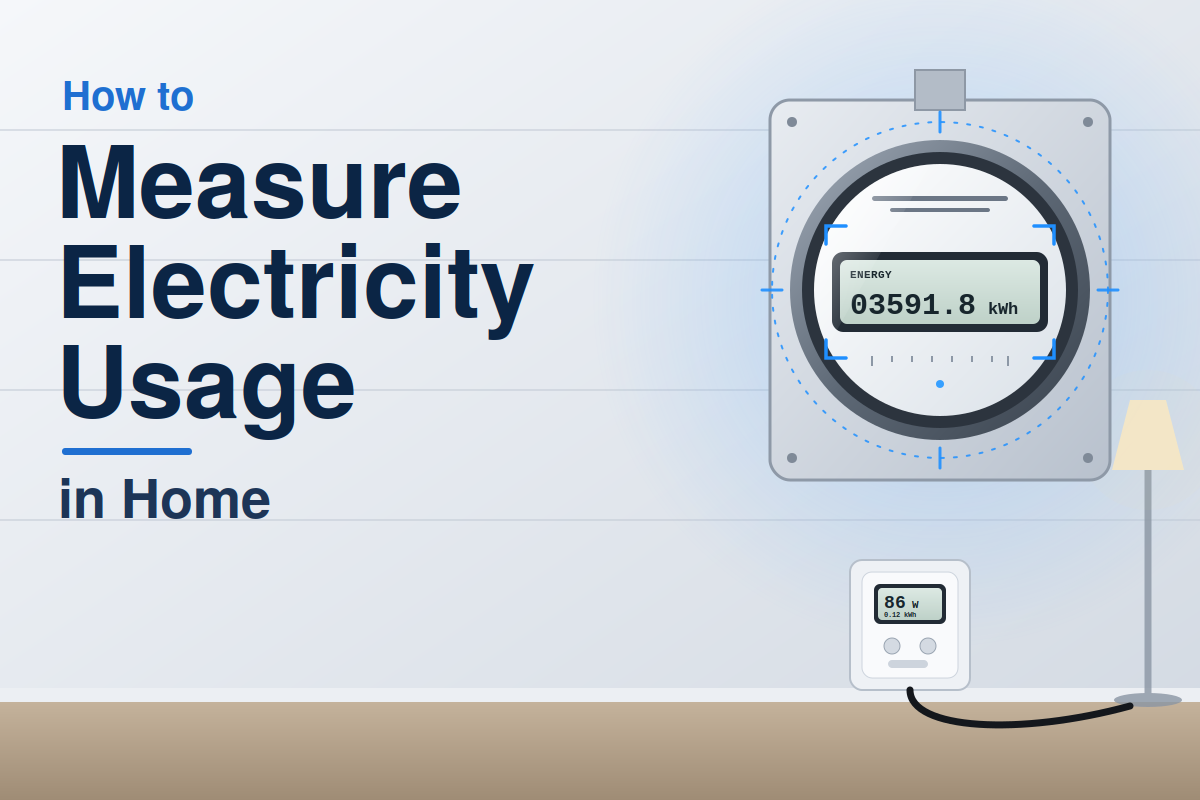
Digital meters can display several values. You may see voltage, current, power factor, total energy, or other readings.
For measuring household energy use, look for the value shown in kWh. Do not accidentally use the voltage or current reading.
| Meter value | Meaning |
|---|---|
| kWh | Energy used |
| V | Voltage |
| A | Current |
How to Measure Electricity Usage by Appliance
Checking the whole-house meter tells you total consumption, but it does not tell you which appliance caused it. That is where appliance-level measurement becomes useful.
A plug-in electricity monitor is one of the simplest options for individual appliances. You plug the monitor into the wall, plug the appliance into the monitor, and let it measure the load.
This is especially useful for appliances that run for many hours.
Which Appliances Should You Measure First?
I would not start by measuring every device in the house. That quickly becomes tedious. Start with appliances that either use a lot of power or run for long periods.
| Appliance | Why measure it |
|---|---|
| Air conditioner | High power use |
| Refrigerator | Runs many hours |
| Water heater | Often high wattage |
| Computer | Can run for long periods |
An appliance may have a modest wattage but still use a lot of energy if it operates all day. That was one of the more useful lessons for me.
How to Calculate Electricity Usage From Watts
You can estimate electricity consumption when you know an appliance’s wattage and how long it runs.
Use this simple formula:
Energy used (kWh) = Watts × Hours ÷ 1,000
For example, a 100-watt fan running for 10 hours uses:
100 × 10 ÷ 1,000 = 1 kWh
For a 1,500-watt heater running for 2 hours:
1,500 × 2 ÷ 1,000 = 3 kWh
| Appliance power | Daily use | Energy used |
|---|---|---|
| 100 W | 10 hours | 1 kWh |
| 500 W | 4 hours | 2 kWh |
| 1,500 W | 2 hours | 3 kWh |
The important point is that wattage alone does not tell you your energy use. Time matters just as much.
Why Appliance Labels Can Be Misleading
One mistake I made was treating the number on an appliance label as its exact, constant power consumption.
That is not always how appliances behave.
A refrigerator compressor cycles on and off. An air conditioner may change its output. A modern inverter appliance can also vary its power draw depending on the load.
So the label is useful for an estimate, but a power meter gives you a better picture of actual use.
Can a Smart Meter Measure Home Electricity Usage?
Yes. A smart electricity meter can provide much more information than a simple meter, depending on the model and utility service.
Some smart meters can record usage at different time intervals. Your electricity provider may also offer an online portal or app where you can view consumption data.
| Method | Best for |
|---|---|
| Standard meter | Total household usage |
| Smart meter | Usage tracking over time |
| Plug-in monitor | Individual appliances |
A smart meter is especially helpful when you want to compare weekday and weekend consumption or look for unusual changes.
How to Find Which Appliances Use the Most Electricity
The best approach is to combine measurement with observation.
First, look at your total home consumption. Then measure the appliances that seem likely to contribute the most. Finally, compare their usage with how often you actually use them.
A Simple Appliance Test
Pick one appliance and measure it for a full day or several days. Record the energy reading before and after the test.
| Test result | What it may indicate |
|---|---|
| High kWh, short runtime | High-power appliance |
| Low kWh, long runtime | Efficient or low-power load |
| Unexpectedly high kWh | Worth investigating |
This method can reveal surprises. A device that feels insignificant may become a meaningful part of your electricity use simply because it operates continuously.
Common Mistakes When Measuring Electricity Usage
Measuring electricity is not difficult, but small mistakes can produce confusing results.
Mistake: Checking Only Wattage
A 1,000-watt appliance does not necessarily use more electricity than a 500-watt appliance over a full day. Runtime changes the result.
Mistake: Taking Meter Readings at Random Times
If you want useful comparisons, measure at consistent times. Comparing a six-hour period with a 14-hour period does not tell you much.
| Mistake | Better approach |
|---|---|
| Reading at random times | Use fixed times |
| Using wattage alone | Include runtime |
| Measuring everything | Start with major loads |
Mistake: Assuming the Electricity Bill Shows Detailed Appliance Use
Your electricity bill normally shows total billed energy, not a breakdown for your refrigerator, lights, fans, or computer.
For appliance-level data, you need additional measurement or monitoring.
How to Track Electricity Usage Over a Month
Once you know how to measure electricity usage in home settings, regular tracking becomes much more useful.
I recommend keeping a simple monthly record. You do not need complicated software. A spreadsheet or notebook is enough.
Record the meter reading on the same day each week. At the end of the month, compare the readings and look for changes.
You can also note major changes, such as:
- Running an air conditioner more often
- Buying a new refrigerator
- Working from home
- Adding a water heater
- Spending more time indoors
These details help explain why electricity consumption changes.
How to Reduce Electricity Use After Measuring It
Measurement is only useful if it helps you make better decisions. Once you know where your electricity goes, focus on the biggest opportunities first.
If an appliance uses a large amount of energy, reducing its operating time can have a bigger impact than switching off a tiny standby device.
For example, reducing heavy air-conditioning use may matter far more than worrying about one small phone charger.
The goal is not to eliminate every watt. It is to understand the loads that actually matter.
Final Thoughts
Learning how to measure electricity usage in home settings changed the way I looked at an electricity bill. Instead of seeing one large monthly number, I could break it down into daily use, appliance use, and changes in my routine.
The simplest starting point is your electricity meter. Take regular kWh readings, calculate the difference, and then use an electricity monitor for appliances you want to investigate more closely. Once you have real numbers, reducing unnecessary energy use becomes much easier.