When you press your foot on the gas pedal, something magical happens. Your engine spins faster. The needle on your dashboard shoots up. That needle shows you the RPM gauge, also called a tachometer. But where did this instrument come from? How did it change over two hundred years? This story is wild.
The automotive tachometer has a fascinating past. It didn’t start in a car. It started with machines in factories. Engineers wanted to measure how fast things spun. They needed to keep machines safe. This one simple tool became essential for cars. Today, understanding the evolution of the tachometer helps us see how far cars have come.
What Is a Tachometer and Why Does Its History Matter?
Let me break this down simply. A tachometer is a gauge that measures how fast your engine spins. We call this speed RPM, which means revolutions per minute. One revolution is one complete spin of the crankshaft.
Think of it like this: if your tachometer shows 3000 RPM, your engine’s crankshaft is spinning three thousand times every minute. That’s fast!
Why should you care about the history of tachometers? Because this tool changed everything. It made driving safer. It helped engines last longer. It let drivers know when an engine was working too hard. Understanding where the tachometer came from helps us understand modern cars better.
The engine RPM measurement isn’t just a fancy feature. It’s critical safety gear. Pushing your engine past its limit causes damage. The tachometer warns you. A red zone on the dial shows the danger area. Ignore that warning, and your engine might break.
The Birth of Speed Measurement (1810-1840)
Bryan Donkin’s Mercury Bowl Innovation (1810)
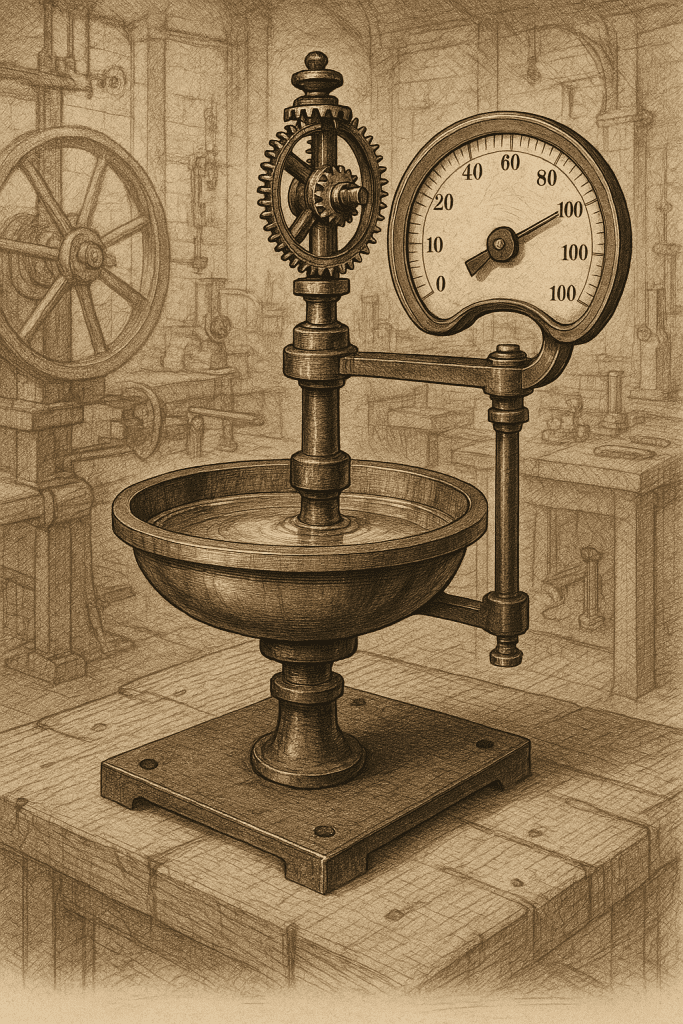
Bryan Donkin’s Mercury Bowl Tachometer (1810) – First speed measurement device
Picture this: England in 1810. The Industrial Revolution is roaring. Factories are everywhere. Machines spin and spin and spin. Owners need to know one thing: how fast are these machines going?
An engineer named Bryan Donkin had an idea. He created the first documented automotive tachometer concept, though it wasn’t for cars yet. It was for machines. He called it a tachometer because of two Greek words: “tachos” (speed) and “metron” (measure).
Here’s how Donkin’s device worked:
Donkin presented this invention to the Royal Society of Arts in London. The society awarded him a gold medal. This was huge. Smart people around the world would hear about his idea.
But Donkin’s tachometer had a problem. Mercury is liquid. It sloshes around. On bumpy roads, the readings jump all over. Plus, mercury is toxic. Still, his idea was brilliant. It showed that measuring speed was possible.
Dietrich Uhlhorn’s Centrifugal Force Tachometer (1817)
Seven years later, German engineer Dietrich Uhlhorn took a different approach. He used centrifugal force in a new way. This is the force that pushes things outward when they spin in a circle.
Uhlhorn’s design was clever:
This device worked better than mercury. No liquid meant no mess. No toxins meant workers stayed healthy. The mechanical design was simple and reliable.
His tachometer first measured machine speeds in 1817. By 1840, it was measuring locomotive speeds. Locomotives needed tachometers. Engineers needed to know how fast trains were going. A runaway train could kill people.
Mechanical Tachometers Enter the Automotive Age (1886-1950s)
From Locomotives to Automobiles
In 1886, something changed everything. Karl Benz built the first gasoline car. It was loud. It was new. It was dangerous.
Early drivers faced a big problem. They couldn’t hear their engines. A driver might push the engine too hard without knowing it. The engine could break.
Drivers needed a way to see engine speed. That’s when tachometers moved from factories and trains to cars.
The first automotive tachometers used cables. A flexible cable ran from the engine to the dashboard. The cable spun as the engine spun. Inside a housing on the dashboard, the spinning cable created measurements. A pointer moved across a dial.
This was mechanical. No electricity required. Simple. Reliable.
Racing Demands Drive Innovation
Here’s where things got serious. Racing cars needed better tachometers.
In the 1920s and 1930s, racecars pushed engines to extremes. Drivers can’t hear anything inside a racecar. They need to see how fast the engine is spinning. They need to know when to stop pushing.
Tachometers became essential in racecars. They had a red zone painted on the dial. This warned drivers: “Go past this speed and something breaks.”
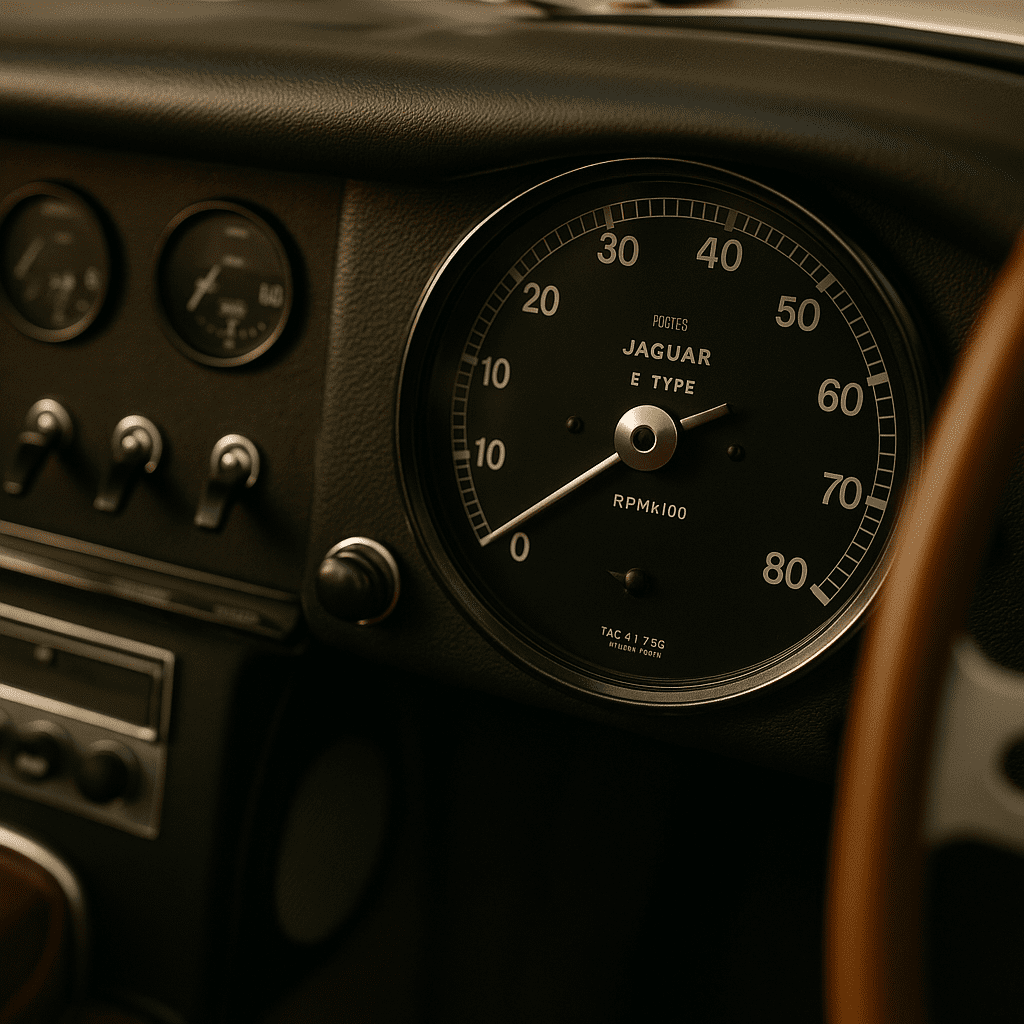
Jaguar E-Type (1961) Dashboard with Iconic Tachometer
This is where the term “redline” came from. Engineers painted a red line on the dial to mark maximum safe speed. If the needle went into the red zone, danger was close.
Racers began shifting gears based on the tachometer needle. They waited for the needle to climb toward the red line. Then they shifted to the next gear. This timing meant better acceleration. Better acceleration meant winning races.
The motorsport instrumentation became the most advanced tachometers of that era. Racing engineers pushed the technology harder than anyone else.
How Mechanical Tachometers Worked
Let me explain how gear-driven tachometers actually worked.
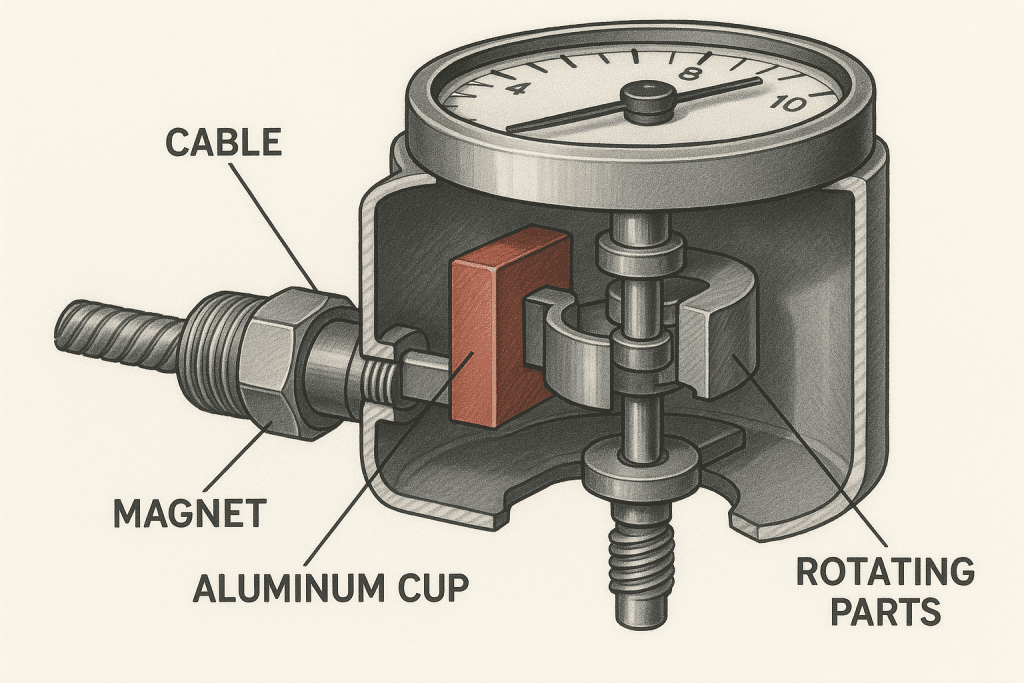
How Mechanical Cable-Driven Tachometers Work –
A cable connected the engine to the gauge. One end attached to a spinning engine part (the camshaft, crankshaft, or fan pulley). The cable twisted as the engine turned.
At the dashboard end, the cable connected to a special mechanism. Inside sat a magnet and a small aluminum cup. As the cable spun, the magnet rotated around the cup. The spinning magnet created electrical currents in the aluminum. These currents were called eddy currents.
Here’s the physics: eddy currents create a magnetic field that opposes the original field. This opposition creates drag. The faster the magnet spins, the stronger the drag. A spring kept the cup in place. A pointer attached to the cup showed the reading.
This system was pure mechanical genius. No electronics needed. The only electricity involved was the small magnetic field.
The best mechanical tachometers came from British companies. Smiths Instruments made famous tachometers. They showed up in Jaguar sports cars, MG roadsters, and Triumph motorcycles. These were beautiful instruments with clear dials and smooth needle movement.
The Electric Revolution (1950s-1980s)
Cost and Reliability Drive Change
By the 1950s, car makers wanted cheaper tachometers. Mechanical models cost too much money. They needed many custom parts. Building them required skilled workers.
Engineers realized something important: they could use electricity instead of cables.
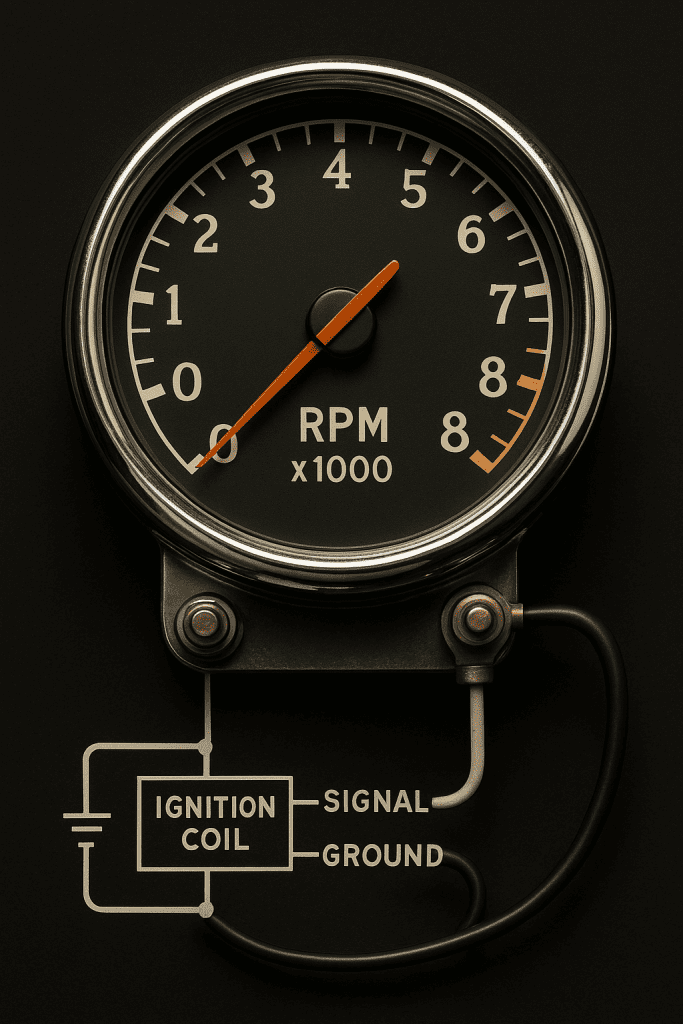
Electric Tachometer Evolution (1950s-1960s)
The first electric tachometers appeared in the late 1950s. By the early 1960s, they were becoming standard. Electric tachometers cost much less to build. They used simple electronics. They needed fewer custom parts.
But early electronic tachometer designs had problems. Some models could short-circuit the ignition system. This was dangerous. By the 1970s, engineers fixed these problems and made them reliable and common.
Electric Tachometer Technology Explained
How did electronic control units read engine speed?
The engine has ignition coils. These coils create sparks for the spark plugs. Each spark happens once per engine cycle. An eight-cylinder engine fires sparks eight times for every two complete crankshaft rotations.
Engineers figured out that by counting sparks, they could calculate RPM.
Here’s the process:
- Signal Generation: The ignition coil produces electrical pulses when sparks fire
- Pulse Counting: A circuit counts how many pulses happen each second
- Frequency Conversion: The circuit converts this count into a proportional voltage
- Display Output: This voltage drives a needle or digital display
- Calibration: Factory-set resistors ensure the reading is accurate
Different cars used different signal sources. Most aftermarket tachometers connect to the ignition coil’s negative terminal. Modern engines use crankshaft sensors. Some vehicles have dedicated tachometer outputs from the ECU.
The beauty of electric tachometers was their simplicity. No mechanical linkage. No cable friction. Just electronics and a needle. This meant better accuracy and longer life.
Sports Cars Adopt Tachometers as Standard (1950s-1970s)
Here’s a fun fact: tachometers became standard equipment on sports cars before regular cars.
Why? Sports car drivers pushed their engines hard. They raced on weekends. They accelerated on country roads. They needed to know engine speed to drive safely.
Look at famous sports cars:
These cars had manual transmissions. Drivers shifted gears themselves. That meant finding the perfect shift point. Too low, and the engine bogs down. Too high, and the engine screams. The tachometer showed the perfect moment to shift.
Regular family cars didn’t have tachometers. Why not? Because automatic transmissions didn’t need them. An automatic transmission decides when to shift. The driver doesn’t need to know engine RPM.
Modern Tachometers and Engine Management Integration (2000s-Present)
Computer-Controlled Precision
Today’s tachometers are part of the engine management system. They get information directly from the engine control unit (ECU).
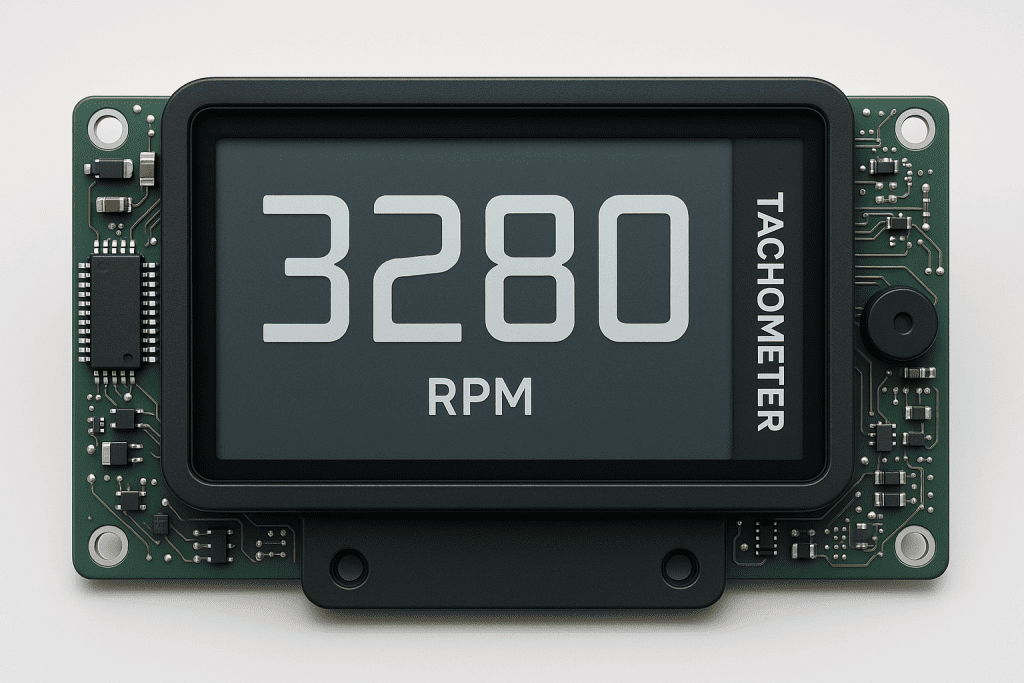
The ECU is the car’s computer. It monitors everything. It controls fuel injection, ignition timing, and more. It knows engine RPM precisely because it calculates it from crankshaft sensor data.
This direct connection means perfect accuracy. The tachometer shows exactly what the ECU calculates. No sensors to fail. No cables to wear out.
Modern electronic control units (ECU) can do something amazing: they can prevent engine damage automatically. They use rev limiters. When RPM approaches the maximum safe limit, the ECU cuts fuel. The engine stops accelerating. It can’t over-rev.
Rev limiters are brilliant protection. A driver can floor the accelerator all day. The engine will never exceed redline. This makes cars safer and engines last longer.
Advanced Features in Contemporary Tachometers
Modern tachometers do amazing things:
Racing cars have the fanciest tachometers. Formula 1 cars have steering wheel-mounted displays. Drivers see RPM, gear, fuel remaining, tire temps, and more constantly.
Understanding the Redline: Engine Safety and the Tachometer
What Is Redline and Why Does It Exist?
Redline is the maximum safe RPM for continuous operation.
Every engine has a limit. Push past that limit, and things break. The redline marks that limit clearly.
What determines redline? Several factors:
Engineers calculate redline conservatively. They want a safety margin. A typical gasoline car has a redline between 6000-7500 RPM. High-performance engines might reach 8000 RPM. Racing engines can exceed 10000 RPM. Diesel engines typically have lower redlines (3500-5500 RPM).
Consequences of Ignoring the Redline
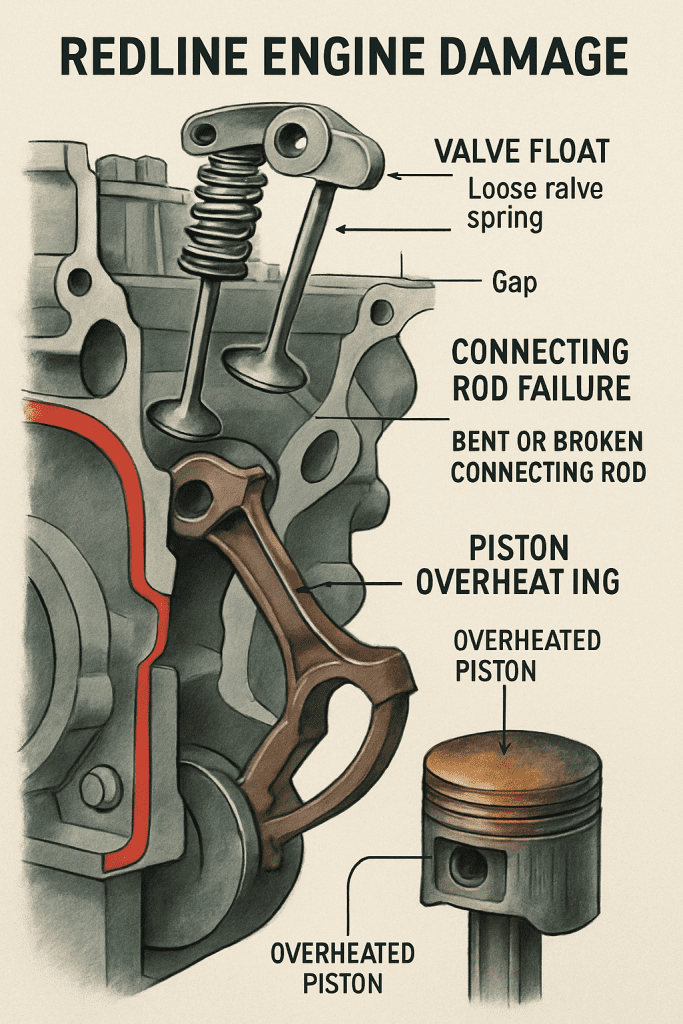
What happens if you ignore the redline? Bad things happen.
Valve Float: At extreme RPM, valves can’t close properly. They “float” open partially. This breaks the seal. Compression escapes. The engine misfires. This can damage valves permanently.
Connecting Rod Failure: Connecting rods connect pistons to the crankshaft. At extreme RPM, the forces are enormous. A connecting rod can bend or snap. A broken rod means a destroyed engine.
Bearing Damage: At extreme speeds, bearing surfaces can’t maintain a proper oil film. Metal touches metal. Friction heats the bearing instantly. The bearing can seize or melt.
But here’s good news: modern engines have electronic protections. Most cars have rev limiters. When RPM approaches maximum, the ECU cuts fuel. The engine cannot exceed the limit.
Types of Tachometers Used in Automotive Applications
Classification by Technology
Tachometers come in different styles. Each measures engine speed but works differently.
Mechanical Cable-Driven Tachometers:
Electric Analog Tachometers:
Digital Electronic Tachometers:
Specialized Racing and Performance Tachometers
Racing tachometers are different animals. They’re built for extreme conditions.
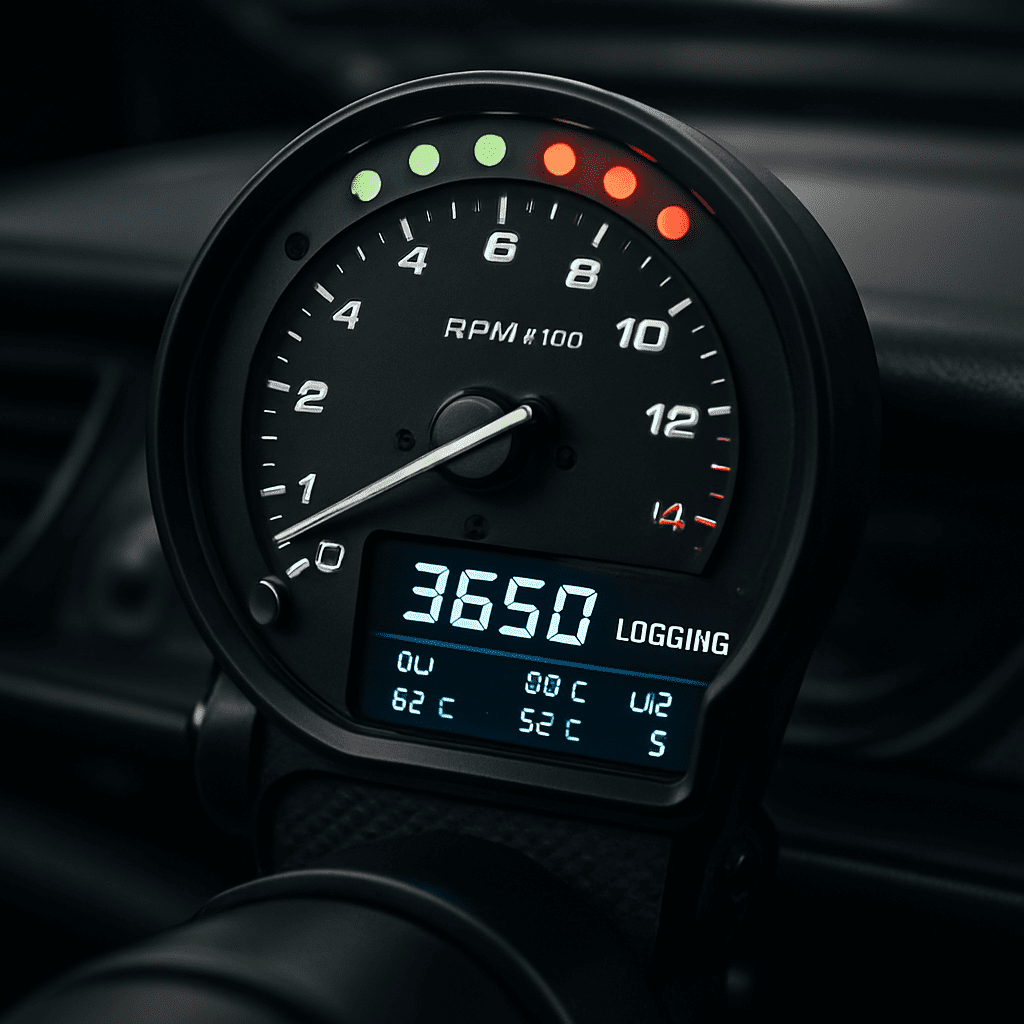
Key racing tachometer features:
Famous racing tachometer brands:
Tachometer vs. Speedometer: Understanding the Difference
Two instruments on your dashboard often confuse people. They sound similar. They look similar. But they measure completely different things.
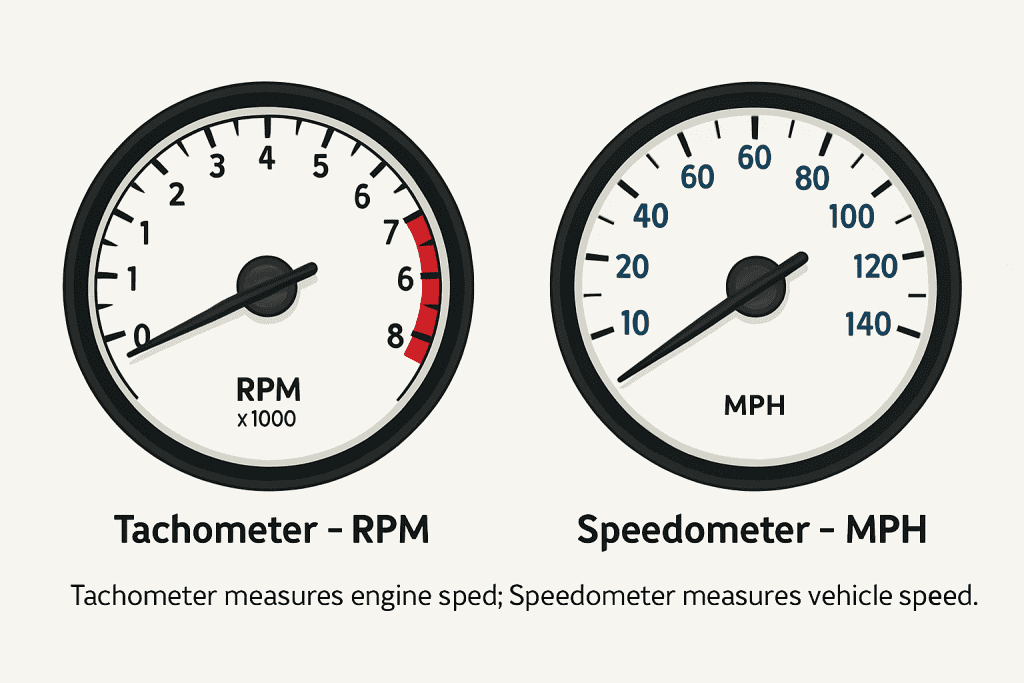
Tachometer measures engine rotation speed (RPM).
The crankshaft spins. A tachometer counts revolutions per minute. That’s RPM. It tells you how fast the engine is spinning, not how fast the car is moving.
Speedometer measures vehicle ground speed (MPH or KPH).
The wheels rotate. Each rotation moves the car forward a certain distance. A speedometer calculates speed based on wheel rotation. It tells you how fast the car is traveling.
Here’s an example: You’re in third gear at a traffic light. Engine idles at 800 RPM. Speedometer reads 0 MPH. The engine is spinning but the car isn’t moving.
The relationship between RPM and speed depends on gear ratio and tire size. Change gears, and the relationship changes. Change tire size, and it changes again.
Why the names are confusing:
Both words technically mean “speed meter.” Automotive convention assigned them different meanings. The names aren’t perfectly logical, but that’s how the industry settled on them.
Frequently Asked Questions (FAQ)
How does a modern car tachometer work?
A car’s electronic control unit (ECU) monitors the crankshaft constantly. It counts pulses from sensors. Based on these pulses, it calculates exact RPM. The ECU sends this information to the tachometer. The tachometer displays the number on a screen or moves a needle. It happens instantly. Modern tachometers are incredibly precise.
What’s the actual difference between a tachometer and speedometer?
A tachometer shows how fast your engine spins (RPM). A speedometer shows how fast your car moves (MPH or KPH). They measure completely different things. You might be at a red light with your engine running at 800 RPM but traveling 0 MPH. The engine spins while the car sits still.
Is a tachometer necessary in an automatic car?
Not necessary for driving safely. But helpful for staying aware. An automatic transmission handles shifting. But if you hear strange noises or feel odd behavior, the tachometer gives clues. It helps confirm the transmission is working correctly.
Why is it called the “redline” on a tachometer?
The term comes from the red paint on the gauge face. Manufacturers painted a red zone to warn drivers visually. The red zone marks maximum safe RPM. It’s impossible to miss. Red always means danger or caution.
What causes a tachometer to stop working?
Many things can fail. Blown fuses are most common. Loose wiring connections happen. The sensor might fail. The gauge itself can break internally. Start with the simplest diagnosis: check fuses and connections. Most problems are here.
Do electric vehicles have tachometers?
Pure electric vehicles typically don’t have tachometers. Electric motors operate differently than gasoline engines. They don’t need RPM limits. They don’t have redlines. Instead, EVs show power output in kilowatts. Hybrid vehicles switch between tachometer mode and power meter mode.
How accurate are tachometers today?
Modern electronic tachometers are very accurate. Within 10-50 RPM for standard gauges. Within 1-5 RPM for better units. Professional racing instruments achieve 1 RPM accuracy. Older mechanical tachometers were less accurate (100-200 RPM tolerance).
What RPM should I shift gears at in a manual car?
For economy driving, shift between 2000-3000 RPM. For normal driving, shift at 3000-4000 RPM. For performance driving, shift near the power peak (usually 500-1000 RPM below redline). Every engine is different. Check your owner’s manual for specific recommendations.
Expert Tips for Using and Maintaining Your Tachometer
Best Practices for Daily Drivers
Use your tachometer wisely in everyday driving.
Watch Shift Points: Automatic transmissions should shift around 2000-2500 RPM in normal driving. If it shifts higher, something might be wrong. Early diagnosis prevents bigger problems.
Keep RPM Low for Economy: Lower RPM means less fuel consumed. If possible, stay under 3000 RPM during normal driving. Use higher gears earlier. This simple habit improves fuel economy by 10-15%.
Warm Up Before High RPM: Don’t immediately accelerate hard when starting a cold engine. Let it warm up first. Wait a minute. Let oil circulate. After a few minutes of driving, the engine is warm. Now acceleration is safe.
Common Mistakes to Avoid
Don’t make these errors.
Ignoring Redline Warnings: Pushing repeatedly into the red zone teaches bad habits. Treat redline as a limit to respect.
Constantly Driving at High RPM: Some drivers keep RPM high all the time. This accelerates engine aging. Fuel economy suffers. Heat increases. Calm, smooth driving is better for everyone.
Lugging the Engine: Driving in high gear at low RPM under load. The engine struggles. Efficiency drops. Power is weak. Downshift to a lower gear instead.
Conclusion
The Tachometer’s Enduring Legacy and Future
We’ve journeyed through two hundred years of tachometer history. From Bryan Donkin’s mercury bowl in 1810 to today’s digital displays, this simple instrument has saved engines and lives.
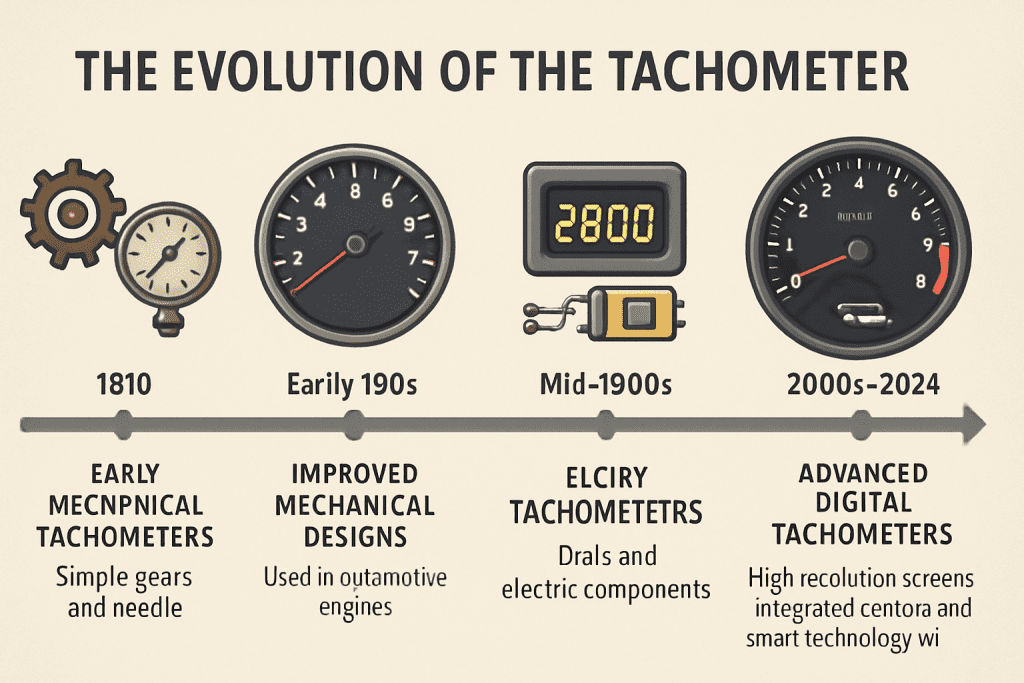
The tachometer history tells a story of human problem-solving. Engineers faced a challenge: how to measure engine speed safely. They found solutions. Each solution improved on the last. Mechanical designs. Electrical innovations. Digital precision.
Today’s modern automotive RPM systems are marvels of engineering. A crankshaft sensor generates data. An ECU calculates perfect RPM. A display shows the information. All this happens instantly.
The automotive tachometer has earned its place in vehicle history. From Donkin’s innovation to today’s digital clusters, this gauge has proven essential. It measures more than RPM. It measures our relationship with machines.
Next time you see that needle move on your dashboard, remember: you’re seeing two hundred years of engineering history. You’re seeing the solutions of brilliant minds working to make machines safer. You’re seeing progress.
The tachometer’s story isn’t finished. As cars evolve, the tachometer will too. But the principle remains: monitoring engine speed matters. As long as engines spin, as long as humans drive machines, the principle of measuring engine speed will endure.
Understanding the evolution of the tachometer helps us understand ourselves. We’re problem-solvers. We’re innovators. We build tools to help us work better and safer. The tachometer represents the best of human ingenuity applied to a practical problem.